Showing posts with label Christianity Today Magazine. Show all posts

Friday, January 26, 2024

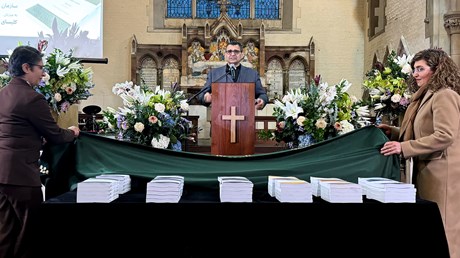
Father Sues Assemblies of God for Alleged Abuse of Teen

Texas lawsuit claims that the minor was a victim of a serial predator as well as student leaders in the campus ministry Chi Alpha.

A church in a Texas college town, a chapter of the campus ministry Chi Alpha, and its sponsoring denomination, the Assemblies of God, are being sued by a father who alleges that the leaders he entrusted to disciple his teenage son instead got him naked in ministry settings and used their positions of authority to sexually abuse him.

The lawsuit, filed Thursday, follows a tumultuous several months for Chi Alpha. Since last spring, a serial predator has gone to jail for child sex abuse, chapter leaders across a half-dozen Texas universities have been dismissed, and the organization’s national director resigned.

The majority of the departing leaders had ties to Daniel Savala, a registered sex offender who groomed and abused Chi Alpha students for decades at his home in Houston. He was indicted last year on child sexual abuse and trafficking charges.

Though Savala wasn’t officially a part of Chi Alpha or the Assemblies of God, the list of leaders who have left reflect the reach of his informal network across Chi Alpha in Texas.

The recent lawsuit alleges that Savala molested a 13-year-old in 2021 and that four Chi Alpha students continued to sexually violate the youth group member through naked and inappropriate games in ministry settings.

The teenage victim attended Mountain Valley Fellowship in College Station. The Assemblies of God church had been led by Eli Stewart, a longtime Chi Alpha leader who launched the chapter at nearby Texas A&M University.

The victim’s father, Stephen Holt, is suing the church and the local Chi Alpha chapter as well as the General Council and North Texas District Council of the Assemblies of God for “malice” and “gross negligence” for failing to warn parents ...

Continue reading...


from Christianity Today Magazine https://ift.tt/q7OGtDQ

Why Young Men Are Failing to Launch

For Gen Z men who feel purposeless and lost, the way off the couch is the way of the Cross.

This piece was adapted from Russell Moore’s newsletter. Subscribe here.

A few weeks ago, I was talking to a group of men—some atheists, some Christians, some Jews; some conservatives, some progressives, some centrists—from completely different geographical, cultural, and vocational backgrounds.

They all wanted to talk about one thing: the number of young men they know who seem purposeless and lost. For some of them, the problem was pressing because it was about their own sons. For most, it was about their nephews or godsons or the sons of their friends and neighbors.

In most cases, they weren’t talking about the sort of things people used to worry about with boys and young men. They weren’t concerned about gang violence or drug addiction or drag racing or street fights. They weren’t even talking about sexual promiscuity or binge drinking. They were talking about something quite different: a kind of hopelessness, a lack of ambition, in some cases even to leave the house at all, much less to go out into the world and start families of their own.

One way to identify this problem is to follow the old tried-and-true path of blaming the next generation for laziness and being coddled. You know you are getting old not when you see the first gray hairs or when your muscles ache from picking up a sock on the floor, but when you see Instagram memes for your generation showing streetlights at dusk with the words Hey Gen Z, this was the app that told us when to come home.

Usually this kind of You kids get off my lawn (or Get on your own lawn instead of gaming on the couch) mentality is vapid—a mixture of self-deceiving nostalgia with We’re better than you generational narcissism.

Plus, those ...

Continue reading...


from Christianity Today Magazine https://ift.tt/vi9qzRk

Thursday, January 25, 2024

Above Reproach? Fewer Americans See Pastors as Ethical

The biblical call to maintain “a good reputation with outsiders” is becoming a bigger challenge in the US as public perception of clergy falls to a record low.

Americans are having a harder time trusting anyone these days—including pastors.

The country’s perception of clergy hit a new low in recent Gallup polling, with fewer than a third of Americans rating clergy as highly honest and ethical.

People are more likely to believe in the moral standards held by nurses, police officers, and chiropractors than their religious leaders. Clergy are still more trusted than politicians, lawyers, and journalists.

The continued drop in pastors’ reputation—down from 40 percent to 32 percent over the past four years—corresponds with more skepticism toward professions (and institutions) across the board.

Americans are also less likely than ever to know a pastor, with fewer than half belonging to a church and a growing cohort who don’t identify with a faith at all.

“As American culture becomes increasingly pluralistic and post-Christian, we can’t assume that Americans in general default to a positive view of clergy,” said Nathan Finn, executive director of the Institute for Transformational Leadership at North Greenville University. “Ministers must work harder to gain public trust than was the case even a generation ago.”

Finn also pointed out how scandals like clergy sex abuse, growing political polarization, and evangelicals’ countercultural moral positions can contribute to the decline in credibility among clergy, “especially among those who have either had bad church experiences or whose worldview assumptions are already at odds with historic Christian beliefs.”

The most dramatic decline in clergy trust came around the crisis of sex abuse by Catholic priests in the early 2000s, when positive ...

Continue reading...


from Christianity Today Magazine https://ift.tt/l9pRP3X

Euthanasia: Why Some Despair Unto Death

As a Christian physician, opposing medically assisted suicide wasn’t enough. I needed to understand why people decide to die.

When I began research for my book on physician-assisted death, I set out to answer the question Why not?—which, at the time, was not a theoretical one. As a doctor specializing in intensive care medicine, I would regularly receive requests from patients for help to end their lives.

In 2014, not long after I had finished my training, serious conversations began about the possibility of legalizing physician-assisted death, and I realized that “where causing death was once a vice, it was soon to be a virtue”—as I shared in a previous piece for CT.

But ever since my country, Canada, legalized MAID (Medical Assistance in Dying) in 2016, I have tried to demonstrate to my colleagues and fellow citizens—beginning with, but going well beyond, my faith convictions as a Christian.

Intentionally causing someone’s death contravenes and violates their incalculable worth. So long as we are committed to upholding the intrinsic value of persons—so long as we insist that their value does not merely derive from their usefulness to others or to themselves—it is inappropriate and unethical for us to seek or to offer physician-assisted death.

More than that, relying on our own sense-experience and human faculties, we cannot confidently claim to know what it is like to be dead. Therefore, it is unwise and imprudent to seek and (especially) to offer physician-assisted death. Both these reasons, I think, count quite strongly, and seem to provide a very good answer to the Why not? question.

Is the case then closed? Not quite, I think.

For to respond effectively to this issue, we must not only address the Why not? question. We must also respond to the Why? question. We must address ...

Continue reading...


from Christianity Today Magazine https://ift.tt/mZlS5o2

Wednesday, January 24, 2024

Five Indian Christians Who Fought for India’s Freedom

Following Jesus’ example, many lived simply, humbly, and selflessly to uplift the poor and marginalized, and their faith in God nurtured their hopes for liberation.

This year, India celebrates the 75th anniversary of Republic Day, a holiday commemorating the nation’s constitution coming into effect in 1950. While the efforts of towering figures like reformers Mahatma Gandhi and Jawaharlal Nehru are widely celebrated, the courageous participation of Indian Christians in the freedom struggle often goes unrecognized.

Following Jesus’ example, many lived simply, humbly, and selflessly to uplift the poor and marginalized of India, and their faith in God nurtured their hopes for Swaraj, or self-rule. From sheltering dissidents to mobilizing women, educating youth to building institutions, these Christian stalwarts contributed in diverse ways. Their work dispels the myth that the Indian independence struggle was solely a Hindu-Muslim endeavor.

Below are five Christian leaders who dedicated themselves to the cause of Indian nationalism and of overcoming British colonial rule. From Kerala in the south to the Punjab in the north, these men and women of faith were driven by a deep patriotism and a desire to see their motherland free.

1. Sushil Kumar Rudra (1861–1925)

When Kasturba “Ba” Gandhi, otherwise known as the wife of Mohandas “Mahatma” Gandhi, returned to India from South Africa in 1915, she and her children were welcomed by Sushil Kumar Rudra, a second-generation Bengali Christian and the first Indian principal of the prestigious St. Stephen’s College in Delhi.

Rudra had traveled to Bombay (now known as Mumbai) specifically to receive the Gandhi family, and he hosted them in Delhi while they awaited Mahatma Gandhi’s arrival from London. He had also been the man largely responsible for convincing Gandhi to return to India.

As principal, Rudra ...

Continue reading...


from Christianity Today Magazine https://ift.tt/wlUuqgt

Iranians Gain 12 New Ways to Read the Bible

Translation agency aims to bring “glory” back to marginalized minority ethnic groups via the New Testament.

Home to the world’s fastest-growing church, with up to an estimated 1 million Christians, Iran has many underground fellowships that had previously worshiped in the Farsi language. But according to a 1991 survey of new mothers in Iran, only 46 percent reported Farsi as their mother tongue.

Minority Gilaki, Mazandarani, and other citizens can now read the New Testament in their own language, thanks to the publication of 12 new Bible translations. Far from a Persian monolith, Iran has 62 distinct languages, according to the Korpu translating agency, 9 of which number more than 1 million speakers.

And God’s concern for Iran goes beyond their individual souls.

“Translating the Bible is God’s way not simply to save people,” said Yashgin, a Korpu exegete-in-training, “but to return glory to humiliated minority peoples.”

Now living in Turkey and a Christian since 2007, Yashgin requested anonymity to protect her believing family back in Shiraz, 525 miles south of Tehran. A member of the Qashqai Turkic minority of Iran, she fled the country after two brief detentions in jail for her faith, connecting with Korpu in 2017.

Seven years later, she helped birth the first Qashqai New Testament.

Yashgin said she was mocked as a child over her accent and Turkish name. (Minority Rights Group (MRG) states that Iran represses its minority languages, mandating Farsi alone in education and civil affairs.) But studying the Bible, she learned that God called Israel as a minority people (Deut. 7:7), and translation, she said, proves the truth of John 3:16.

God loves the world, not just the majority.

“No one cares for us more than our mother,” Yashgin said. “God showed us he cares also, by speaking ...

Continue reading...


from Christianity Today Magazine https://ift.tt/qt03np2

One Underrated Way to Enrich Your Christian Political Witness: Be a Better Christian

Personal discipleship and spiritual formation are hardly irrelevant to the rough-and-tumble of public debate.

As another election year begins and Americans brace for what will undoubtedly be another contentious presidential race, Michael Wear’s new book, The Spirit of Our Politics: Spiritual Formation and the Renovation of Public Life, has an important message for us: If politics is causing you to stumble, care less about it.

It’s an intriguing message from a political consultant who now runs The Center for Christianity and Public Life, a nonprofit dedicated to bringing more robust Christian presence and resources to political life in America. After all, politics has defined Wear’s career, beginning when he somehow managed to finish his undergraduate degree while working for President Barack Obama (first as an intern on his presidential campaign, then in the White House Office of Faith-based and Neighborhood Partnerships).

You might expect, in an election year, to hear calls to whip ourselves into a greater fervor because the stakes are so high. But Wear has written a book that urges the exact opposite. If there’s ever a conflict between political victory and moral faithfulness, he argues, we ought to choose faithfulness every time.

Rejecting silence and subservience

Indeed, the central contention of The Spirit of Our Politics is that undisciplined political fervor and a desire to defeat our political enemies is poisonous for our spiritual health. We must first seek the kingdom of God before aspiring to participate in political action.

Wear is deeply concerned that the toxicity and rancor of American politics are seeping into American churches, leading to the use and abuse of Christianity as a blunt instrument in political discourse and furthering a mass epidemic of shallow faith defined less by trust in God and ...

Continue reading...


from Christianity Today Magazine https://ift.tt/TMYoj8X

After New Hampshire, Evangelicals Brace for Another Trump Nomination

Is the church ready for a repeat?

After former president Donald Trump bested former South Carolina governor Nikki Haley in New Hampshire on Tuesday, the GOP primary outcome that many have expected all along may soon be here.

“This race consolidated faster than any race I can remember,” Dan Darling, director of the Southwestern Baptist Theological Seminary’s Land Center for Cultural Engagement, told Christianity Today. “It’s feeling a little bit like an incumbent candidacy.”

Haley outlasted a large field of presidential hopefuls, but after a second-place finish in the Granite State, her underdog campaign may soon run out of road, political analysts say.

“New Hampshire has a much more moderate and much less religious electorate than South Carolina, and she still could not win,” said Kyle Kondik, an elections analyst with the University of Virginia Center for Politics. “The bottom line is that I think she needed to do better in New Hampshire to demonstrate wider appeal among the base Republican electorate.”

In New Hampshire, she also performed well with college graduates and self-identifying moderate and independent voters. But nearly 9 in 10 of New Hampshire voters who considered themselves “very conservative” supported Trump, The Washington Post’s exit polling found. And white evangelical Christians—about 20 percent of voters in the contest—went for Trump by 70 percent.

Trump won support from a strong majority of white evangelical voters in the 2016 and 2020 presidential elections, but his popularity also heightened ideological divisions within churches.

“Christians should be preparing now for a really divisive and contentious campaign season,” ...

Continue reading...


from Christianity Today Magazine https://ift.tt/a0hfEcq

Tuesday, January 23, 2024

‘Past Lives’ Is the Anti-‘Notebook’

We’ve romanticized stories of destiny-driven love—even at the expense of fidelity. This Oscar-nominated drama shows the beauty of limits.

Last year, I watched The Notebook for the first time. For nearly 25 years, it has epitomized Hollywood romance, with stills of Allie (Rachel McAdams) cupping Noah’s (Ryan Gosling) face as they passionately kiss in the rain serving as a pop culture shorthand for love and destiny.

The Notebook is also a story of infidelity. The story toggles between the present, where an elderly Noah comforts an Alzheimer’s-afflicted Allie, and the 1940s, where Allie cheats on and ultimately leaves her fiancé to reunite with Noah after years apart. In the modern scenes, Noah models faithfulness despite its difficulty, but in the earlier part of their timeline, Allie’s unfaithfulness is presented as the peak of romance.

The 2023 film Past Lives, which was nominated for five Golden Globes and Academy Awards including best picture, subversively shows the extent to which that impermanent perspective has permeated our thinking about life and love. Nora (Greta Lee) lies in bed with her husband Arthur (John Magaro), who is processing his feelings about an upcoming visit from his wife’s former love interest, Hae Sung (Teo Yoo):

Arthur: I was just thinking a lot about what a good story this is.

Nora: The story of Hae Sung and me?

Arthur: Yeah, I just can’t compete.

Nora: What do you mean?

Arthur: Childhood sweethearts who reconnect 20 years later only to realize they were meant for each other.

Nora: We’re not meant for each other.

Arthur: In the story I would be the evil white American husband standing in the way of destiny.

“I’m the guy you’re leaving,” Arthur reiterates later, “when your ex-lover comes to take you away.”

Arthur’s confession surely echoes the inner narrative ...

Continue reading...


from Christianity Today Magazine https://ift.tt/J0DeKkw

Evil Is as Evil Does

The Zone of Interest, nominated for Oscars including Best Picture, is a Holocaust horror movie about the corruption of the human heart.

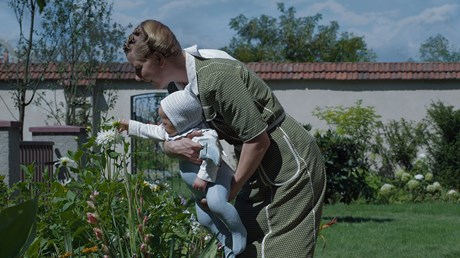
The verdant and blooming garden outside the family home in The Zone of Interest, nominated for 2024 Academy Awards including Best Picture and Best Director, could appear in some celebrity’s home tour on YouTube. In the yard, the mother swoops her baby down close to sniff various flowers. “This one is phlox,” she says.

But all is not lovely here. Audiences might have a hint from the two minutes of complete darkness that begin this razor-sharp film that something is wrong in this Eden. The family dog sprints anxiously through most of the immaculate shots, grabbing food off the sumptuously set tables and knocking things over. Just over the garden hedge, you can see the puffs of smoke from a train going by. At night, there is a strange red glow on the bedroom walls, and no one seems to be able to sleep.

This is 1944, and the Höss family live in their beautiful home next to the gate of Auschwitz concentration camp, of which Rudolf Höss is the commandant. This part of the story is historical fact: Höss was the real commandant of Auschwitz, responsible for creating an efficient machine for destroying human lives. He later confessed he’d overseen the killing of 3 million people.

But The Zone of Interest, an antiseptic term Nazis used to describe the area around Auschwitz, doesn’t include that kind of historical detail about World War II or the Holocaust. Director Jonathan Glazer, who spent ten years on this project and shot it on location at Auschwitz, knows audiences have seen many such movies and may, by now, be numb to their presentation of those horrors. Instead, he drops the audience straight into the Höss family life as they swim and eat birthday cake. Only slowly do we absorb ...

Continue reading...


from Christianity Today Magazine https://ift.tt/9hziIMv

Monday, January 22, 2024

Nicaragua’s Relentless Crackdown on the Church Continues

Even with the recent release of imprisoned priests, Ortega’s regime continues to target Christian organizations with an “absolute intolerance for dissent.”

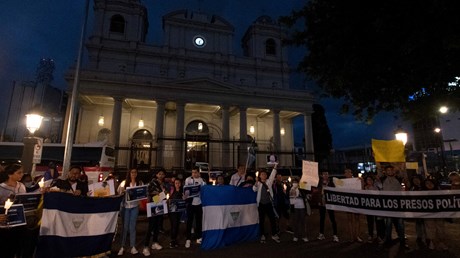
Bad news has been the norm for Catholics in Nicaragua, where clergy and church groups have been frequent targets of a wide-ranging crackdown for years. But on January 14, 2024, they received a happy surprise: The government unexpectedly released two bishops, 15 priests and two seminary students from prison and expelled them to the Vatican.

Those released included Bishop Rolando Álvarez, a high-profile political prisoner who was detained in 2022 for criticizing the government and then sentenced to 26 years in prison for alleged treason.

They also included priests detained by President Daniel Ortega’s government in late December 2023 for expressing solidarity with Álvarez and other political prisoners. Days later, Pope Francis criticized the regime in his New Year’s message and then called for “respectful diplomatic dialogue.”

Nearly six years after mass protests erupted against Ortega and then were brutally repressed, these prisoner releases offer some hope to Nicaragua’s opposition. As my research has shown, however, the Ortega regime is unrelenting in trying to retain power, which suggests this is not necessarily a turning point. In fact, the government reportedly took yet another priest into custody on January 16.

Why target the church?

Ortega first led Nicaragua from 1979 to 1990, after his left-wing revolutionary organization, the Sandinista National Liberation Front, or FSLN, spearheaded the overthrow of dictator Anastasio Somoza Debayle. In the 1980s, the FSLN clashed with the Vatican and church hierarchy over the group’s socialist politics, even as many poorer Nicaraguan Catholics embraced them.

When Ortega took office again in 2007, however, he did so with the blessing of ...

Continue reading...


from Christianity Today Magazine https://ift.tt/NiuZFMD

Wrestling with Awkward Stories in the Old Testament

Cringeworthy passages can derail our yearly Bible reading plans. How do we interpret them?

On a recent trip to Egypt, the chefs at our hotel put out a remarkable buffet of culinary delights presented with both excellent taste and exquisite aesthetics.

One of our group members served onto his plate a beautiful spread: a cucumber disc topped with a triangle of cheese, a baby tomato, and a swirl of what looked like a dessert mousse. Sitting back at our table, he took a bite, and his eyes went wide as he grimaced. “What is this?!” he cried. That sweet mousse turned out to be liver pâté—not at all what he was expecting!

It’s the time of the year when many Christians embark on a new Bible reading plan. Reading through the Bible from cover to cover is a wonderful practice that exposes us to its less-familiar passages. We may discover new treasures along the way, tucked between the stories we know.

But we may also encounter passages we’d rather spit out of our mouths, like my friend’s liver pâté. Expecting inspiration, we may instead find hard words, troubling scenes, or confusing episodes. Especially if we hoped for an endorphin-generating Bible study—a “feel-good” devotional to carry us through our day—we can often find ourselves disillusioned.

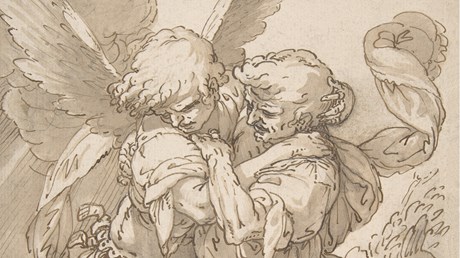
As a Bible scholar, I’ve devoted my life to reading and understanding the Scriptures. I’ve watched the pages of the Bible come alive over and over again. Even so, I still encounter passages that trouble me. But I keep in mind something another Bible scholar and friend of mine, Esau McCaulley, once said—which is that we should engage with such difficult passages in the same way Jacob interacted with the angel in Genesis 32:

After a lengthy absence, Jacob was heading home to Canaan. ...

Continue reading...


from Christianity Today Magazine https://ift.tt/bqf4LGa

Friday, January 19, 2024

Grace in the Age of Guilt

Rules and moral codes won’t save us in an era of judgment, hate, and superego. What will save us is mercy.

This piece was adapted from Russell Moore’s newsletter. Subscribe here.

Years ago, I talked with someone who told me how hard it was to keep a moral grounding in the sex-fueled drinking atmosphere of his college. That’s not unusual, but then he told me more about his college.

Turns out it wasn’t a party school but a fundamentalist separatist Christian college, where holding the hand of a date would get a student suspended and dancing would get a student a ticket back home. It’s the kind of place where the student conduct manual is longer than the federal code for maintaining nuclear reactors.

I said, “So in spite of all that strictness, the people there were wild?” He said, “The people there were wild because of all the strictness.”

He went on to talk about getting in trouble for listening to a contemporary Christian music artist (the beat is too worldly) or for his hair being too long or for breaking some other regulation.

“After a while, you start to lose the sense of what’s really bad and what’s not,” he said. “Your conscience gets broken when you know you’re going to be a rule breaker no matter what you do. Once that happens, it’s—well, it’s party time.”

I thought of that man as I read Mark Edmundson’s book The Age of Guilt: The Super-Ego in the Online World. Like in that conversation, my first thought when seeing this book was, What age of guilt? This is an age of shamelessness. His argument, though, was different than what I expected, and it’s one that those of us who are Christians should take seriously.

Politico’s Michael Schaffer sums up the fractured nature of American life right now this way: ...

Continue reading...


from Christianity Today Magazine https://ift.tt/5HKJVLA

Thursday, January 18, 2024

Why 100,000 Pro-Lifers Still March in DC

Even after the reversal of Roe v. Wade, evangelical activists see a bigger fight to change Americans’ minds on abortion.

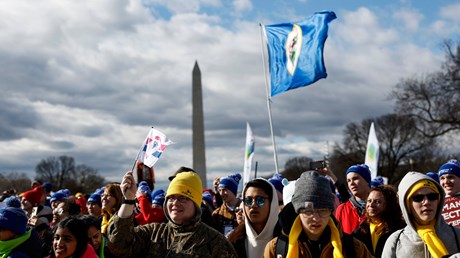
Catholic activist Nellie Gray organized the first March for Life in 1974 to mark the anniversary of the Supreme Court ruling that legalized abortion nationwide. Fifty years later, even after the 2022 decision overturning Roe v. Wade, pro-life activists don’t feel like their work is done.

After Dobbs v. Jackson Women’s Health Organization, the organizers of the national march, which is considered the largest annual pro-life gathering in the world, “thought that it was possible last year that we’d have a little bit less of a crowd,” Jeanne Mancini, president of March for Life, told Christianity Today.

“And much to my delight, that was wrong. We had a really big crowd last year, a very energized crowd, and we anticipate nothing less this year.”

Days before the 2024 event, an arctic blast sweeping much of the US blanketed Washington, DC, closing area schools and delaying flights for the thousands of participants traveling to the capital. Friday’s forecast projects another dusting of snow.

But pro-life organizers don’t expect the inclement weather to deter turnout: They estimate the crowd could be 100,000 people. The crowd will draw from student campus activists, worshipers from evangelical and Catholic churches, staff from pro-life nonprofits, and volunteers from all over the country.

“We’re proud to be there every year en masse, you know, showing the nation that this generation rejects abortion and that we’re moving forward in our mission in this post-Roe world,” Kristan Hawkins, founder and president of Students for Life of America, told CT.

Hawkins anticipates more conversations this year about the pro-life movement’s goals moving forward, particularly ...

Continue reading...


from Christianity Today Magazine https://ift.tt/ZVquiyk

He Fact-Checks Christians Who Have Experienced the Worst

He’s an East African researcher for Open Doors. The work has counterintuitively affected his faith.

Nearly two decades ago, Fikiru joined a prayer and Bible study group in his hometown in East Africa, an experience that led him to accept Christ as his personal savior. But Fikiru soon found that other Christians in the area vehemently opposed his and the rest of his community’s conversions. Over a period of months, these Christians accused the others of blasphemy, forced their spouses to divorce them and their families to cut them off, and in some cases beat and killed them.

One Sunday, in the aftermath of this persecution, several staff members of the global Christian persecution advocacy group Open Doors stopped by.

“We’d never met them,” said Fikiru. “We’d never heard of them.”

But Open Doors had heard of his church and how it was suffering. They had a simple message for Fikiru: You are not alone.

Within a couple of years, Fikiru (CT is using his pseudonym for security reasons) took a job at Open Doors.

“I’m trying to pay back for the love and concern that was shown to me while I was a persecuted believer,” said the research analyst for East Africa, an area that runs from Eritrea to Mozambique. “I do this role with passion and spirit.”

Fikiru recently spoke with global managing editor Morgan Lee about how he fact-checks persecution claims, the surprising impact this work has had on his faith, and how he cares for staff members who are worn down from this work.

How do you help staff who get burned out or secondarily traumatized hearing so many stories of devastation, destruction, and violence?

Prayer. One of our core values emphasizes that we are people of prayer. We know that we are serving the Lord, and these people are suffering for their faith. They are ...

Continue reading...


from Christianity Today Magazine https://ift.tt/QkfECwY

Tim Alberta Is More Sad Than Angry at His American Evangelical Family

The Atlantic journalist’s portrait of a fractured movement chooses lament over axe-grinding.

Donald Trump might pose problems for established political norms, but he has been a godsend for book publishers. In the years encompassing Trump’s first campaign, election, inauguration, tumultuous term as president, second campaign, and unprecedented response to defeat in 2020, dozens of books have been written about the relationship between white evangelical Christians and Donald Trump’s populist politics.

The latest of these is Tim Alberta’s The Kingdom, the Power, and the Glory: American Evangelicals in an Age of Extremism. A journalist for The Atlantic, Alberta combines memoir and research, drawing on his upbringing in and familiarity with the evangelical tradition to interrogate what historian Thomas Kidd describes as “a movement in crisis.”

This crisis is both political and personal. It is political in that white evangelicals have been the steadiest base of support for the least outwardly faithful president in half a century, at the alleged expense of their prior platitudes about morality and ethics being central to public service. But, as Alberta explains, it is also deeply personal, leading to rifts in families, communities, and congregations.

As the title hints, The Kingdom, the Power, and the Glory is organized into three sections, each focusing on a different element of the evangelical movement and its evolution over the last decade in response to changing political tides. Alberta crisscrosses the country visiting churches and political rallies, interviewing pastors and activists, and trying to make sense of what he sees as too many evangelicals sacrificing a Christian approach to the political world at the altar of power. The result is a book that is well resourced and eminently readable, ...

Continue reading...


from Christianity Today Magazine https://ift.tt/BnIvQtE

Why Singaporean Churches Don’t Talk About Abortion

As young people become more accepting of abortion, pro-life ministries encourage pastors to talk about sex and unplanned pregnancies.

When Eliora found out she was pregnant in 2021, she didn’t tell her church community as she felt ashamed about getting pregnant outside of marriage. Instead, she started researching abortion on the internet. When she told her partner, whom she was not in a committed relationship with, he gave her a list of abortion clinics in the area.

Eliora, 29, was also unsure about her church’s stance on abortion, as she had never heard the topic talked about from the pulpit or in small group. Two weeks later, she terminated the pregnancy, thinking it was the most logical choice. (CT agreed to use only her first name due to the sensitivity around abortion in Singapore.)

However, what she thought was a one-off decision soon plunged her into overwhelming guilt. “Deep down, I just had this sense that if it is a life, then I have killed something. It just felt wrong,” Eliora said. “I wish that my [church] community was a space [where] I felt safe to reach out for help.”

Stories like Eliora’s are not uncommon in Singapore, where abortion is a largely taboo topic in the church. At the same time, Singapore has one of the most liberal abortion laws in the world due to the country’s former family planning policies in the ’70s. Abortion is legal up to 24 weeks of pregnancy and not restricted by age. Minors do not need to obtain parental consent to get an abortion.

While the number of abortions in Singapore has halved in the past decade—likely due to the increased use of contraceptives and the growing acceptance of single mothers—approval of abortion has increased in the younger generations, including among Christians. A third of Christians between the ages of 18 to 35 believe abortion ...

Continue reading...


from Christianity Today Magazine https://ift.tt/0MXvpnz

Adoption Was Beautiful, Precious, and God-Ordained. Then I Adopted.

Facile expectations hurt everyone in the process, including my new son.

A few months into the COVID-19 pandemic, after putting my three kids to bed one night, I streamed a National Theatre production of Jane Eyre while squeezing in some exercise on our stationary bike. A chill crept through me as I found myself identifying not with Jane but with her vindictive aunt, who unwillingly becomes Jane’s adoptive mother.

I was horrified to share Mrs. Reed’s resentment toward Jane for being an outsider, an intruder, a bringer-of-problems. This was the same sentiment I found myself fighting daily toward our five-year-old adopted son, whom we’d welcomed into our family over a year prior. Watching my own feelings manifested on screen in Mrs. Reed—a villain—brought home to me how defective my moral compass had become.

As a child who always wanted to make the world a better place, I’d taken to heart the value that Christians, from the early church to modern American evangelicals, have placed on care for orphans. And the way adoption was portrayed in sermons and the Christian books I read was universally positive: Adoption was a metaphor for God grafting us into God’s family (Rom. 8:14–17, Eph. 1:5); adoption met a crucial need; adoption was a beautiful act of love. Being a gregarious evangelist or an on-my-knees prayer warrior might not be my strength, but welcoming a child I could do.

When I started dating my future husband, I had just returned from a summer volunteering with disabled children in a Chinese orphanage. Adoption was always part of how we envisioned we would build our family and extend God’s capacious love to kids in need.

After getting married and having two biological children, with my medical training finally complete and our lives relatively ...

Continue reading...


from Christianity Today Magazine https://ift.tt/K6a9cfD

Wednesday, January 17, 2024

How Colombia Became South America’s Hardest Country to Be a Christian

Officially, the country protects religious liberties better than most in the region. On the ground, it's more complicated.

Rodrigo is a Christian fisherman who lives with his wife in the department of Chocó, a jungle region near the border Colombia shares with Panama and one of the wettest places on earth.

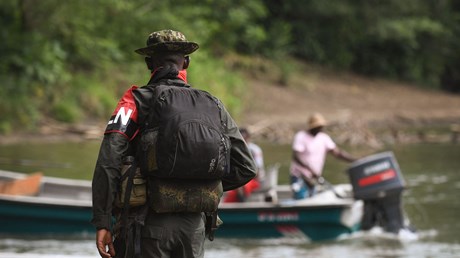
Due to its remoteness, the town does not have paved streets, and the presence of police and other Colombian authorities is scarce. Residents primarily travel the mighty Atrato, Baudó, and San Juan Rivers by motor boat, and Rodrigo supports his family by selling gas, as reported by Open Doors, which first told his story.

Despite the seeming necessity of his business, Rodrigo and his family are isolated. The majority indigenous community in the area where the family lives has rejected them because of their faith and have socially and economically excluded them due to their refusal to participate in the animistic rituals that are common among the natives. This isolation has also made Rodrigo vulnerable to the regionally dominant guerrilla and paramilitary groups, who periodically threaten to shut down his business if he doesn’t pay extortion fees—a crime that affects the whole country but is even worse for Christians.

Rodrigo’s story encapsulates two of the biggest reasons Colombia has been the most dangerous country in South America in which to be a Christian over the last five years, according to Open Doors’ World Watch List (WWL). On this year’s list of the most difficult places to be a Christian, the country ranks No. 34 globally. So how did a nation with a long democratic tradition and a Catholic majority become one of the most precarious places for believers in the Western Hemisphere?

Much of Colombia’s notorious violence dates back to 1948, when the liberal presidential candidate Jorge Eliécer ...

Continue reading...


from Christianity Today Magazine https://ift.tt/RwCx6Lf

Tuesday, January 16, 2024

Xi Jinping Is Not Trying to Make Christianity More Chinese

The primary goal of Zhongguo hua is not cultural assimilation but political domestication. Yet I'm more confident than ever that house churches will survive.

December was the most challenging yet most hopeful month for Christians in China.

Before Christmas, the 11th National Chinese Christian Congress (NCCC) was held in Beijing. The quinquennial congress elected new leaders of the officially sanctioned National Committee of the Three-Self Patriotic Movement and the nominal China Christian Council. Top political advisor and politburo member Wang Huning charged these groups with strict oversight of churches and with maintaining an unwavering allegiance to the Chinese Communist Party (CCP).

Under the party’s instruction, the NCCC passed a new five-year plan to “continue to promote the Chinanization of Christianity and run Chinese churches well in accordance with the socialist society.” Meanwhile, the new and sweeping Patriotic Education Law, which took effect on January 1, requires religious leaders to conduct patriotic education and guide their religion by the socialist principles of the CCP.

Persecution continues to be real

Throughout December, the authorities once again tried hard to contain and curb Christmas celebrations inside and outside churches, prohibited students and others from participating in Christmas activities, and detained some house church leaders to prevent them from organizing congregational gatherings.

Yet most churches, both the officially sanctioned churches and unregistered house churches, held Christmas Eve and Christmas Day worship services. The online evangelistic galas by Beijing Zion Church and other house churches on Zoom and other platforms are of high artistic quality. Christians shared discreetly on social media that church leaders baptized a number of new believers despite the current “bitter winter” for churches in China. ...

Continue reading...


from Christianity Today Magazine https://ift.tt/bQZPXr3