Tuesday, May 2, 2023

Getting Out of Bed Is an Act of Worship

Especially when you face the mundane burdens of enduring suffering while living with mental affliction.

In 2 Corinthians 1:8, Paul confesses that at one point he suffered so much affliction that he “despaired of life itself,” which is a remarkable statement—and not the kind of declaration you would expect from one of the greatest apostles of Christ.

But despairing of life is a surprisingly common sentiment in Scripture. The prophet Elijah asks God to take his life (1 Kings 19:4). Job laments that he was not immediately “carried straight from the womb to the grave” (10:19). The preacher of Ecclesiastes (4:2–3) and the prophet Jeremiah (15:10) similarly wished they had never been born.

Whether the reason for such distress is religious persecution, personal loss, evil’s prevalence in the land, or the burden of being a prophet of God, despairing of life is not an abnormal experience.

We see similar trends today. According to the CDC, the rate of suicide among males aged 15–24 rose 8 percent in 2021, and according to Mental Health America, over 20 percent of adults are experiencing a mental illness.

There are several possible explanations for these rising rates of mental affliction—but for those who are suffering, there is a much more immediate question: Why get out of bed only to endure such mental misery?

While it may seem morbid to ask such a question, it’s necessary for us to have an answer.

Life is filled with joy and beauty, but at one time or another, each of us will face the challenge of mental suffering. For some of us, it will take the form of a diagnosed mental illness. For others, it will come in the form of life’s many travails. We do a great disservice to one another by recognizing mental suffering only when it has an official diagnosis. ...

Continue reading...


from Christianity Today Magazine https://ift.tt/C3rQoRA

UK Coronation Remains Religious, Even if the Country Isn’t

With King Charles’s ceremony, Christians debate the theology of the monarchy and celebrate a unique opportunity for public witness.

Last year, a Washington Post journalist interviewed Ian Bradley, a professor of cultural and spiritual history here in the United Kingdom, about the accession of King Charles III to the throne. The reporter remarked, “For a country which is so secular and where so few go to church, you sure mention God a lot.”

It’s a fair comment. As monarch, King Charles is not only the head of state for the UK but also the Defender of the Faith (a title given to King Henry VIII by the pope in 1521 before the king’s famous break with the Roman Catholic Church) and Supreme Governor of the Church of England.

When he is crowned this week in Westminster Abbey, he will be anointed with holy oil by the Archbishop of Canterbury while the choir sings “Zadok the Priest,” an anthem used in every coronation since 973 that draws on the anointing of Solomon by the priest Zadok in 1 Kings.

“It is the coronation more than any other event that underlines the sacred nature of the United Kingdom monarchy,” writes Bradley in his book God Save the King: The Sacred Nature of Monarchy. “At their coronations kings and queens are not simply crowned and enthroned but consecrated, set apart and anointed, dedicated to God and invested with sacerdotal garb and symbolic regalia. Here, if anywhere, we find the divinity which hedges the throne.”

All of this will take place in a country in which, as a recent census revealed, fewer than half the population describe themselves as Christian. The Church of England’s own statistics suggest that just 1.5 percent of the population attend a weekly service, while a 2018 British Social Attitudes survey found that 43 percent of us “never or practically never” ...

Continue reading...


from Christianity Today Magazine https://ift.tt/nRgo7Xx

Religious Freedom Violations Go West

Annual watchdog report expands to Latin America, continues to cite China, Iran, and Saudi Arabia among 28 nations restricting minority faiths.

While longstanding offenders in Asia and the Middle East remain epicenters of persecution, Latin America and Europe occupy more space in an annual chronicle by the US Commission on International Religious Freedom (USCIRF).

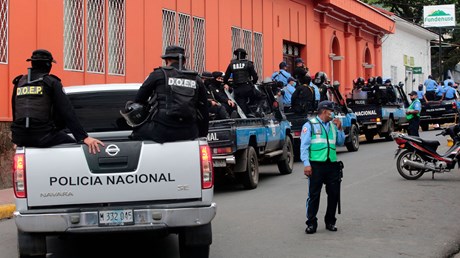
For the first time, Cuba and Nicaragua are labeled Countries of Particular Concern (CPC), according to the independent watchdog. Its 2023 report also makes special mention of the religious rights of indigenous communities in Mexico, Chile, and Colombia. And France, Germany, and Ukraine are highlighted as examples where minority believers have suffered for their faith.

The report’s greatest emphasis, however, is monotonously familiar.

The commission recommends the US State Department relist Burma (Myanmar), China, Eritrea, Iran, North Korea, Pakistan, Russia, Saudi Arabia, Tajikistan, and Turkmenistan as CPCs, in addition to Cuba and Nicaragua. Afghanistan, India, Nigeria, Syria, and Vietnam were recommended for additional designation.

Violations in these nations are “systematic, egregious, and ongoing.”

USCIRF chair Nury Turkel highlighted Iran in his opening remarks. The nation brutally represses its minority communities, he said, and this past year cracked down on protestors peacefully demonstrating against mandatory hijab laws.

Mahsa Amini, who died in custody, was the feature image of the 2023 report’s cover.

“USCIRF is disheartened by the deteriorating conditions for freedom of religion or belief in some countries,” said Turkel. “We strongly urge the Biden administration to implement USCIRF’s recommendations.”

These include listening to the independent commission.

The report expressed “great disappointment” that India and Nigeria were not included ...

Continue reading...


from Christianity Today Magazine https://ift.tt/jD7q6wU

Khartoum Churches Damaged as Sudan Descends Closer to Civil War

As foreigners evacuate, Sudanese Christians remain caught in the crossfire of rival generals.

Sudan’s most Christian neighborhood is under attack.

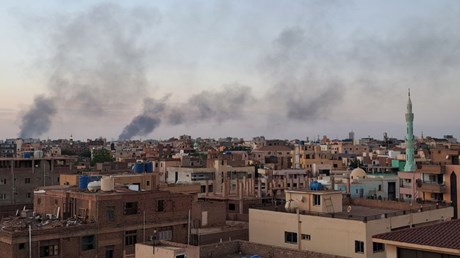
Collateral damage amid severe clashes between the army and its previously partnered militia, churches in the Bahri district of the capital Khartoum and surrounding areas have witnessed the worst of the past three weeks of fighting.

The Evangelical Presbyterian church suffered a fire as munitions exploded in a nearby market. The Coptic Orthodox church was struck by a rocket. And All Saints Anglican Cathedral was occupied by militant forces.

Over 500 people have been killed, with more than 4,000 injured.

“The situation is very serious,” said Ismail Kanani, general secretary of the Sudanese Bible Society. “I am trapped in my house, without power and water.”

Prices for food and fuel are skyrocketing, electricity supply has been cut off in much of the capital, and hospitals have been looted and are barely operating. A three-day truce has been agreed—and violated—to allow civilian escape and embassy evacuations.

Almost all Christians have left the area, said Abdalrahim Musa, director of the Evangelical Cultural Center of the Bahri Presbyterian church. An eyewitness to the carnage, like many other Christians he fled three hours south to Wad Madani, an area relatively distant from the conflict.

But in their absence, he hears reports of widespread looting of their properties.

They are not the only ones displaced. More than 100,000 people have fled Sudan, according to the United Nations, with an additional 334,000 displaced within the country.

Foreign governments have frantically sought to evacuate their citizens. Under cover of armed drones, the US organized a land convoy for 300 Americans and other nationalities to the Red Sea city of Port Sudan. ...

Continue reading...


from Christianity Today Magazine https://ift.tt/LqnGiu6

Monday, May 1, 2023

Our Aging Politicians Are a Warning to the Church

Trusting the next generation to take our places is an act of faith.

This piece was adapted from Russell Moore’s newsletter. Subscribe here.

Sitting in the coffee shop, I overheard two women at the next table talking politics. I expected to hear the typical red versus blue partisan talking points, but I was wrong. They were talking about age.

“I don’t ask for much,” said one woman with a sigh. “I just hope whoever’s hand is on the Bible at the end of it all isn’t wearing a MedicAlert bracelet.”

I don’t know whether these women were Democrats, Republicans, or Independents. They didn’t give away who would get their votes. They were just lamenting the fact that the frontrunners of both major parties are hovering somewhere around 80 years old.

By the end of the next presidential term in 2028, current president Joe Biden, who announced his reelection campaign this week, would be 86, and Donald Trump would be 82. The woman sighed again, asking, “Don’t we have anybody younger than these two?” Her question applies to far more than a presidential campaign. Democratic senators are concerned about the prolonged absence of 89-year-old Sen. Dianne Feinstein (D-Calif.), some of them speaking on background about what they perceive as her cognitive decline. Chuck Grassley (R-Iowa), a dean of the Senate who was reelected in 2022, is also 89. A few years ago, when I brought a group of Southern Baptist pastors to meet with some senators, Grassley kicked things off by complaining about how loud the drums were at his Baptist church back home. Despite pollsshowing that most people agree with the two women in the coffee shop, next year’s campaign does seem—barring a health event—to be about choosing which octogenarian ...

Continue reading...


from Christianity Today Magazine https://ift.tt/V7e1Gor

After My Dad Died, God Didn’t Answer My Anguish

But he gave me something more enduring.

On Thanksgiving week the year I turned 11, my father had a heart attack and died suddenly in his sleep. My parents had divorced when I was two, and my dad lived by himself in an apartment in suburban Atlanta.

He was a man of exceptional kindness and gentleness, gifted in music and patient with the elderly. But when I visited him on the weekends, I got the impression things weren’t going well for him. He was overweight and sedentary, and his apartment was often full of empty pizza boxes and fast-food wrappers, disheveled clothes and dirty dishes. He had remarried after my parents split up, but that relationship had foundered as well, so he was alone when he died. In the parlance of our times, I would classify my dad’s passing as a “death of despair.”

I was shooting hoops at my grandmother’s house when my mom arrived and tearfully broke the news to me. As a preteen, the unfamiliar, highly physical sensation of grief was terrifying to me. It was not unlike seasickness, except that I could not find the horizon. I was overcome by a brutal combination of anxiety, nausea, and vertigo, a visceral experience that over the years I’ve come to refer to as “the pit.”

A brief encounter with this toxic brew of emotions made me dead certain I needed to move on from the pain as quickly as possible. No one in my family told me I needed to, and in fact, to her great credit, my mom did everything in her power to keep me connected with my dad’s family and his memory until I left home.

But I silently intuited the existential danger posed to me by my father’s death. If I become vulnerable to the suffering, I thought, I will enter an unremitting darkness and chaos with no companions or guides ...

Continue reading...


from Christianity Today Magazine https://ift.tt/kS5XcMO

My Church Band Raised a Hallelujah on Netflix’s ‘Beef’

LA pastor Jason Min talks about worshiping on set and the bigger conversations the series spurred about the Korean American church.

Netflix’s miniseries Beef has been making waves for its uncomfortably accurate depiction of the Korean American church experience.

The show tells the story of struggling contract worker Danny Cho (played by Steven Yeun) and successful business owner Amy Lau (Ali Wong) who get into a road rage altercation. Rather than turn the other cheek, the two swear revenge on each other.

The Korean American church comes into play early in the show’s third episode. Danny goes to church after deciding against setting Amy’s car on fire (which only escalates from there). As he enters the service, the band’s arrangement of “O Come to the Altar” overwhelms him, and he breaks down in tears. A pastor takes notice and then comes over to pray for him. The show features other contemporary worship songs such as “Raise a Hallelujah” and “Amazing Grace.”

Pastor Jason Min, lead pastor of Citizens LA, an Asian American church in the heart of Los Angeles, had a role in crafting the music for those church scenes. His brother, actor Justin H. Min, is in the cast.

Min and other Korean Americans see that the authenticity in its portrayals extends beyond just music. In an article for NBC, Minjung Noh, a scholar in Christianity and gender, said that the show also captured elements of “misogyny and patriarchy” in the Korean church.

In one scene, after Danny has become integrated as a praise band leader, his mother tells him to introduce his younger brother Paul to some girls at the church. Noh shared how often in the Korean American church, you go to church to meet women, and the women aren’t in leadership but rather supporting roles.” (Offscreen, the show’s creators have also ...

Continue reading...


from Christianity Today Magazine https://ift.tt/F8Wjm4A