Wednesday, October 4, 2023

Worship in a Time of Trauma: New Releases Offer Songs for Healing

Christian artists open up about mental health, abuse, and loss.
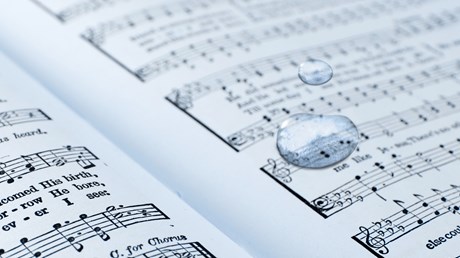
Working in a level-four neonatal intensive care unit (NICU) for over 12 years, Grace Assad has cared for newborns with heart defects, rare genetic disorders, and risky surgery recoveries. Navigating infant loss is part of her job.

She’s also a songwriter and musician, making music with her husband Peter under the name “poems of grace.” Their latest single, “Held,” came as a cathartic expression of grief and heartbreak after sitting with a family through a traumatic loss. Assad wanted the song to be a gift to hurting parents and her NICU coworkers.

The cutting lyrics don’t obscure the aching reality of loss:

Darkness shrouds where light began
Unwelcome guest breaking in
Quiet crib, weeping room
Beating breast, needless food

Assad’s new release is part of a recent outpouring of Christian music that explicitly addresses contemporary suffering.

While songs of lament have always been a part of Christian worship, this cohort of Christian artists are singing about issues that can carry stigma in church settings, including trauma, abuse, and mental health. Their raw, confessional lyrics invite believers to name their struggles and speak about them honestly with God and their communities.

Like many who face grief and pain, Assad said she feels tempted to put up emotional barriers to cope with the loss she sees in the NICU. But remaining sensitive and open is important to her—and part of why she put her experiences into her music.

“I want to be strong, but I want to stay soft,” said Assad. “Human beings can endure a lot, sometimes at the expense of the walls we build up.”

Artists like Assad are hoping that by choosing honesty and vulnerability, listeners and worshipers ...

Continue reading...


from Christianity Today Magazine https://ift.tt/sqEah4V

Green Card Change Leaves Thousands of Foreign-Born Pastors in Limbo

The wait for those with religious worker visas suddenly grew by years due to a procedural shift, and advocates and attorneys fear they could lose their place in the US.

Albert Oliveira was excited. He had come to the US from Brazil in 2010 on a student visa, graduated from Southwestern Baptist Theological Seminary, began pastoring a growing church, married, and started a family.

But he and his wife, a German citizen, would need green cards to remain in the US and allow Oliveira to continue his pastorate at First Baptist Church of Gordon, Texas.

In the middle of their application journey in April, the US government unexpectedly changed the rules and effectively added years to their wait. The R1 nonimmigrant religious worker visas he and his wife hold will expire before they can even apply for green cards under the new process.

“Now we’re just trapped in a limbo,” Oliveira told Baptist Press.

The Oliveiras and their American-born toddler have little chance of legally remaining in the US past February 2024, having already exhausted more than three of the five years their R1 visa will be active.

“It’s just a longer wait that exceeds what we are allowed to stay here legally. Attorneys themselves say we would have to leave the country at the end of the five years,” Oliveira said. “Basically, the whole religious worker category is useless. You’d have to go to another category to even have a chance of staying in the US.”

Oliveira and his family are among thousands. Churches, ministries and attorneys are advocating for change.

The US government issued 6,300 nonimmigrant religious visas in 2018 before the COVID-19 pandemic when applications slacked, and issued 5,900 in 2022, according to the American Immigration Lawyers Association (AILA), among those seeking change.

“What is really disappointing to us is the egregious nature of it, is that they ...

Continue reading...


from Christianity Today Magazine https://ift.tt/gtXUGZ9

Tuesday, October 3, 2023

A Tribute to a Quiet Baseball Star in an Age of Christian Celebrity

Instead of flashy religiosity, Tim Wakefield had a privately influential faith.

With the regular season over and playoffs beginning today, the baseball world is honoring retiring Tigers hitter Miguel Cabrera and Guardians manager Terry Francona, while mourning the deaths of Orioles great Brooks Robinson and beloved Red Sox pitcher Tim Wakefield.

Wakefield had a long career, winning 200 major league games from 1992 to 2011. He had a short life, dying at age 57 following surgery for brain cancer. And one line in his Wikipedia bio is most important: “Wakefield became an evangelical Christian in 1990.”

There’s a lot behind that sentence, and yet I was a little puzzled that none of The Boston Globe’s four stories about him Sunday evening mentioned his faith—nor did articles on ESPN or in The Athletic.

They did report his stats and his biggest win, receiving the Roberto Clemente Award in 2010—which goes to only one major league player each year and is said to represent baseball’s best through sportsmanship and community involvement.

Red Sox principal owner John Henry spoke of Wakefield’s “warmth and genuine spirit,” as well as his “remarkable ability to uplift, inspire, and connect with others in a way that showed us the true definition of greatness.”

Team chairman Tom Werner said, “It’s one thing to be an outstanding athlete. It’s another to be an extraordinary human being. Tim was both.” Likewise, Red Sox CEO Sam Kennedy said Wakefield “exemplified every humanitarian quality in the dictionary.”

But how did Wakefield’s Christian faith underlie all those good qualities? None of the business leaders connected the dots, at least in their press release statements.

Betsy Farmer ...

Continue reading...


from Christianity Today Magazine https://ift.tt/3nvO9Ae

Monday, October 2, 2023

Chapter 2: Adapt to Survive

To survive COVID-19, leaders were forced to adapt at a relentless and unpredictable pace.

The declaration of a worldwide pandemic in March 2020 and the cascade of health policies that followed forced pastors and congregations to rapidly respond. Because no churches wrote “close our doors” in their three-year goals, everyone had to learn quickly and make adjustments simply to survive.

In his article on power, privilege, and adaptive leadership in 2020, Todd Bolsinger framed the crisis in two phases: "First is the acute phase where you're just trying to survive." Second, is "the adaptive phase, where you actually use the energy of the crisis to address underlying issues."

What's clear in our research is that almost all churches faced acute changes because state and local restrictions, building arrangements and church demographics are different, the changes that everyone made were different as well.

What's less clear is whether churches actually adapted to how people live post-pandemic, and whether those changes will last.

Based on Chapter 2 of the report, in this episode host Aaron Hill (editor of ChurchSalary) sits down with two researchers from the Arbor Research Group, Ebonie Davis and Jon Swanson, to talk about the common experience of adapting in order to survive. Featuring an in-depth interview with Eric Blauer, a local pastor leading a church in the Pacific Northwest, about his experience of rapid adaptation during the pandemic.

Hosted by Aaron Hill, Editor of ChurchSalary

"COVID and the Church" is produced in conjunction with the Arbor Research Group and funded by the Lilly Endowment, Inc., through a grant from the Economic Challenges Facing Pastoral Leaders (ECFPL) initiative.

Executive produced by Aaron Hill, Terry Linhart, and Matt Stevens

Director for CT ...

Continue reading...


from Christianity Today Magazine https://ift.tt/M9JnXNB

12 Scholars Who Brought the Bible into Chinese

Each had unique translation philosophies, diction preferences, and intended audiences in mind, frameworks that informed how they approached their all-consuming work.

In the early morning of August 1, 1895, a brutal incident occurred in Fujian province, China. Hundreds of rioters ambushed a group of foreign Christian missionaries who were vacationing in the mountains, resulting in 11 deaths and five injuries. Among the martyred were several women and children, including a 13-month-old baby.

Coincidentally, on the same day the tragic news reached England, the British and Foreign Bible Society received a letter from a pastor from Fujian, pleading for the publication of a Bible written in a local dialect. The next year, the sister of one of the victims helped publish this Bible, and relatives and friends of the martyrs donated toward the publication costs in remembrance of the massacre.

The Kienning Colloquial Bible is only one of numerous Bible translations that began to appear starting in the 19th century and into the beginning of the 20th, due to the painstaking work of many Western and Chinese translators. The translators were often men, and no one knew how hard they worked better than their wives, who had to force their husbands to eat and sleep because of their never-ending ruminations.

Some of these projects focused on producing a literal word-for-word version of the Bible while others sought a colloquial style. In 1872, a team of 16 Western missionaries and several Chinese Christian experts began work on the Chinese Union Version (CUV) with the intent that it be “in the national language (not local vernacular), simple enough to be understood by people from all walks of life, and faithful to the original text without losing the rhythm of the Chinese language,” as Kevin Xiyi Yao, an expert in world Christianity and Asian studies, wrote for CT.

Below, we highlight 12 of the ...

Continue reading...


from Christianity Today Magazine https://ift.tt/153bCzT

Died: Uwe Holmer, Pastor Who Forgave a Communist Dictator

When the East German government collapsed, the evangelical minister welcomed Erich Honecker into his home for 10 weeks.

For Uwe Holmer, the question wasn’t simple. But it was clear.

Did he believe what Jesus said?

The East German dictator Erich Honecker was asking for his help. Honecker had long been an enemy of the church, a powerful ideological opponent of Christianity who had worked to suppress and control people of faith in the German Democratic Republic, and he had personally harried and harassed Holmer’s own family for years.

But now the Communist leader had been pushed from power, driven from his home, turned out of a hospital onto the street—and he was asking the Lutheran church to take him in.

Holmer had to decide what he believed.

He knew what the answer was.

“Jesus says to love your enemies,” he explained to his neighbors at the time. “When we pray, Vergib uns unsere Schuld, wie wir vergeben unseren Schuldigern”—forgive us our sins as we forgive those who sin against us—“we must take these commands seriously.”

The evangelical minister accepted the deposed dictator into his home in January 1990 and cared for him and his wife Margot for two and a half months. The action shocked Germans, East and West, as the 40-year division of the country suddenly collapsed. As the Cold War came to a surprising end, the German people didn’t know what was going to happen next or how they should treat those on the other side, now that the political and military barriers were gone.

The until-then unknown pastor offered one bold answer: forgiveness and hospitality. Hate, Holmer said, is “not a good starting point for a new beginning among our people.”

Holmer, known in Germany as “the man who Honecker lived with,” died on September 25. He was 94.

“Uwe Holmer was ...

Continue reading...


from Christianity Today Magazine https://ift.tt/JTfjMl5

Christian Whistleblower Who Won $70M Was Motivated by ‘Moral Clarity’

Sarah Feinberg said she had the responsibility to do the right thing when she discovered fraud at her government contractor employer.

Sarah Feinberg was a Marine Corps combat veteran, a Wharton Business School graduate, and a Christian mother of three when she left her job at one of the country’s biggest defense contractors—and filed a lawsuit under a whistleblower statute. Feinberg says she was prompted by the Holy Spirit and her moral convictions.

Eight years later, in September 2023, her role as a whistleblower netted a $69.8 million payout, a portion of one of the government’s largest procurement settlements to date at $377.45 million.

Back in 2015, Feinberg had discovered that her employer, Booz Allen Hamilton, was essentially billing the US government to cover the costs of its unprofitable work for other countries and for private sector companies, according to the Department of Justice (DOJ).

After trying to fix the billing problems internally for nine months, she came to believe that Booz Allen had no intention of ending their method of defrauding the US government. She resigned in 2016, got a lawyer, and filed a qui tam lawsuit under the False Claims Act.

The act levies monetary damages against those who attempt to swindle government programs. It also allows private citizens to sue on the government’s behalf and get a portion of the settlement or compensation. After several years of investigation and negotiations, Booz Allen and the US government settled.

Feinberg lives in the Washington, DC area and works as CFO at National Journal. She also volunteers as her church’s treasurer.

During an interview with CT on the first not-too-hot day of autumn, she apologizes for the noise of the helicopters flying above.

“The worst is when the Ospreys come through,” she says of the aircraft known for their noise and powerful ...

Continue reading...


from Christianity Today Magazine https://ift.tt/PjCXLJI