Tuesday, November 7, 2023

Your Calling Is Christ, Not Marriage

Paul’s advice to stay unmarried—like his advice for any circumstance—is about complete devotion to Christ.

It’s good to remain unmarried.

These words aren’t mine but the apostle Paul’s (1 Cor. 7:8). Yet despite their source, they’re not words we’re likely to hear enthusiastically preached from evangelical pulpits today.

I don’t recall being very aware of these words from Paul when I married young, just out of Bible college, where the faculty told girls they’d actually come for an “MRS degree” and gave classes on Christian family and marital responsibilities. In the years since, I’ve heard countless sermons on marriage, some describing it as the “pinnacle of creation,” others telling me that every woman’s “greatest joy in life” is being a wife and mother.

And my experience isn’t unusual. Church classes on marriage are de rigueur. Christians have reams of publications on marriage and traditional family values. Polling shows white evangelicals really do emphasize marriage and children in a way that most other religious groups do not: They think marriage is “important to living a fulfilling life.” And a recent CT article argued that nowhere does the Bible endorse long-term singleness that is not deliberately chosen for the sake of the gospel.

What would Paul make of all this noise about marriage? What would he think of our tendency to assume the experience of marriage is universal, our arguments that Christians should seek marriage, and the assumption that it’s an essential component of the life of faith?

He might wonder why we give so much attention to something that can compete with our devotion to the Lord. He might say: Stop talking so much about marriage—I think these singles will flourish ...

Continue reading...


from Christianity Today Magazine https://ift.tt/CxemoUB

Monday, November 6, 2023

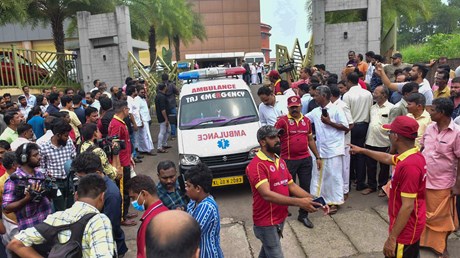
Kingdom Halls Reopen After Blasts at Jehovah’s Witnesses Convention in India Kills Four

The bombing is the first major attack on the community of 1.4 million since its beginnings in the country in 1905.

Kingdom halls reopened for in-person gatherings on Sunday near the area of an October 29 fatal bomb attack at a Jehovah’s Witnesses prayer convention in Kochi, a city in the Indian southern state of Kerala.

“We decided to return to physical meetings from today to remove the fear from people’s minds. The online meetings were held only for a few days following the blasts,” T. A. Sreekumar, a spokesperson for the community, toldThe Times of India.

Four people lost their lives and more than 50 were injured in a series of explosions that tore through a packed conference. About 2,300 people, including many families with children, were attending the three-day event. The bombs went off immediately following the conclusion of a prayer session.

Authorities identified Leyona Paulose (55), Kumari Pushpan (53), Libina Pradeepan (12), and Molly Joy (61) as victims of the attack.

The police investigation was initially centered on covert operatives of radical Islamist fringe outfits seen as adversaries to pro-Israel evangelical groups. But the investigation took a turn after a local resident turned himself into the police station that same day and confessed to the crime. He has been detained by the police as a suspect and has been described as a “disenchanted” member of Jehovah’s Witnesses.

The casualties would have been higher, but the organizers had conducted a mock drill for the participants earlier that weekend, claimed Manoj K. Das, one of the first journalists on the scene.

“The devotees had a rather clear idea of where the exit points were,” said Das. “Now this has definitely helped in evading a stampede in the chaos that followed. Otherwise, we would have been dealing with a ...

Continue reading...


from Christianity Today Magazine https://ift.tt/miVn2Aj

Sudanese Protestant Church Destroyed in All Saints Day Bombing

The largest and second-oldest church in Omdurman was hit following similar bombings targeting local evangelical schools.

At least two Christian buildings were bombed last week amid fighting between rival military factions in Sudan, sources said.

Last Wednesday, a Sudan Evangelical Presbyterian Church building in Omdurman came under heavy shelling from the Sudanese Armed Forces (SAF) that left its worship structure in ruins, two sources with the church said. Local Christian leaders also confirmed the shellings in statements to CT.

The Church of Our Savior was the largest church in Omdurman and hosted worship for both Evangelical Presbyterians and Episcopalians.

When the bombs struck around 9 p.m., several people were at the compound, which includes an orphanage, but were unhurt. The church building was hit three times, causing severe damage especially to its roof. Everything inside was destroyed, including Bibles and hymnbooks, one of the sources said.

“Pray that peace comes to Sudan,” said one of the church members who escaped injury.

According to Christian Solidarity Worldwide (CSW), “Most of the buildings registered to the Evangelical Church in the surrounding area were confiscated under the rule of Omar al-Bashir, and the latest shelling took place approximately three weeks after similar bombings of the Evangelical Commercial School and the Evangelical Secondary School, both in Omdurman.”

CSW reported that the Protestant church was the second-oldest in Ombdurman after the Coptic Church.

Anglican Bishop Ezekiel Kondo told CT that the church, which “has been a place of worship for the last 81 years or so,” was destroyed on All Saints Day. “We will update you as to who might be responsible for this barbaric act between the two warring parties,” he stated. “Thank you for your continued prayer for ...

Continue reading...


from Christianity Today Magazine https://ift.tt/eP9tXUz

After Ohio Train Derailment, Christian Mom Runs for Mayor

Q&A with Misti Allison, who entered local politics because she saw her East Palestine community struggling.

Election Day is on Tuesday for many local races, if not national ones, and one town of about 5,000 in northeast Ohio will be electing a mayor. In February, East Palestine was the site of a fiery train derailment of cars that sent hazardous materials into the air, dirt, and water of the town. The disaster brought the small town into the national spotlight, and the cleanup of the town is ongoing .

The current mayor, Trent Conaway, has been the face of the town’s response to national media and ran unopposed in the last election. On Tuesday he will be facing off with Misti Allison, a 35-year-old Christian who works in software marketing and is a wife and mom of two. She already serves on East Palestine’s library board and on the community advisory board for a scientific study in the aftermath of the explosion. Earlier this year, Allison testified in Congress about the shortcomings of the derailment response.

Allison and her family attend First Church of Christ in East Palestine, the largest church in town and the only one with a full-time pastor. The church has been a staging ground for some of the derailment relief efforts, providing heavy duty air purifiers to the town’s residents as well as free legal clinics. CT spoke with Allison at her church back in September when signs were first appearing in yards for her mayoral run.

You and your family decided to stay in East Palestine after the derailment despite the unknowns about the air, water, and everything else?

Home is home, and we have so many roots here. We love East Palestine. We love our house. We love our family being here. We love the neighborly feel. We love our church. My husband coaches youth sports.

How are you feeling about the different reports about ...

Continue reading...


from Christianity Today Magazine https://ift.tt/c2Aq1Bz

Younger Pastors Took the Brunt of the COVID-19 Burden

New research shows most ministers under 34 saw job responsibilities change and worried about their mental health.

Michael Prevett spent his first few months in ministry measuring out the distance between chairs.

The 33-year-old discipleship pastor says that, to a lot of his peers, going into ministry at all “sounds a little crazy.” But it was even worse in January 2021 when he left his job as a project manager at a construction company and joined the staff at Seven Mile Road Church in Melrose, Massachusetts, just north of Boston.

The pandemic seemed to have put everything important on pause.

“The most difficult thing was the sense of waiting,” he told CT. “It felt like for me, I got an extended time to work on the boat instead of just working in the boat.”

An extensive new study on the long-term impact of COVID-19 on the church from ChurchSalary, which is ministry of Christianity Today, and Arbor Research found that younger ministers were hit especially hard by the pandemic.

Nearly 60 percent of those under 34 took on new responsibilities during the pandemic. About half of those also saw their titles change. That took a toll.

The younger a pastor was when COVID-19 hit, the study found, the more likely the pastor was to consider quitting. Only 14 percent of those between 45 and 54 had serious thoughts about leaving ministry. But 22 percent of pastors between the ages of 35 and 44, 29 percent between 25 and 34, and 37 percent between 18 and 24 thought about it a lot.

Younger pastors also worried about the impact the pandemic was having on them personally. More than 60 percent of those under the age of 35 said they were moderately to severely concerned about their mental health.

Many of them spent the pandemic grappling with how to help their churches adapt to the continually changing situation and sometimes ...

Continue reading...


from Christianity Today Magazine https://ift.tt/fr6lbV2

Saturday, November 4, 2023

Chapter 7: Friendly Fire in the Culture War

Lasting damage was inflicted not by restrictions imposed from outside the church but by politicized conflicts inside each congregation.

Pastors frequently cited COVID-19 as a source of political polarizing and ideological conflict in focus groups, interviews, and survey comments. A pastor in Jackson, Mississippi reflected, “We couldn’t please anybody. You had this binary thinking about everything that was happening.”

A second pastor shared,

Over the past 24 months, the most challenging aspect has been the emotional toll that COVID has brought onto the church staff. Between being both wrong and right with every decision made, and the stress that comes with always feeling that you have to defend your decision to a group of congregants, the stress can become unbearable.

Before COVID-19, the battle lines between politics, faith, and community in many American churches were already overlapping. During the pandemic, they seemed to disappear entirely.

As you listen to this week’s discussion, please understand that our desire is simply to shine a light on what actually happened—the lived experiences of countless pastors and congregations across America. Our sole aim is to facilitate reconciliation, healing, unity and the proclamation of the Gospel, and our prayer for the American Church is the same as Jesus in John 17:20–21:

“I ask not only on behalf of these but also on behalf of those who believe in me through their word, that they may all be one. ... so that the world may believe that you have sent me.”

Based on chapter 7 of the report, in this episode host Aaron Hill (editor of ChurchSalary) sits down with two researchers from the Arbor Research Group, Jesse Brown and Tyler Greenway, to talk about the negative effects of polarization on pastors and congregations. This episode also features interviews with several pastors ...

Continue reading...


from Christianity Today Magazine https://ift.tt/AYcjqfy

Wednesday, November 1, 2023

The History of Chinese Bible Translation Is Full of Cooperation

Western missionaries collaborated with Chinese Christian scholars to translate the Word of God, leading to the achievement of the Union Version.

One author once said that in the hearts of many Christians, the Chinese Union Version (CUV) Bible is “the only Chinese Bible; everyone calls it the ‘Chinese Bible’ and not the CUV.”

Another praised the CUV as “a collection of the essence of a hundred years of Bible translation,” a “culmination of the efforts of countless Chinese and Western scholars, with many terms derived from [Robert] Morrison’s translation.”

Although there have been several high-quality Chinese translations in recent years and the CUV has undergone revisions, the early history of Protestant Chinese Bible translation clearly testifies to Chinese-Western cooperation and global collaboration, laying the foundation for different Chinese translations in the future.

The Bassett Version and the first translations

When Robert Morrison arrived in Guangzhou in 1807, China operated under the Canton System, restricting foreigners’ activities to the port of Guangzhou and imposing limitations on their interactions with the Chinese.

During his studies and translation work, Morrison heavily relied on a copy of the New Testament known as the British Museum Manuscript, which he acquired from his Chinese teacher, Yong Sam-tak, in London. This manuscript was later identified as a translation of the New Testament done by French missionary Jean Bassett and Chinese believer Johan Su (or Xu) in Sichuan. However, Bassett’s translation reached only the first chapter of Hebrews before his death in 1707, leaving the task unfinished.

This copy significantly influenced Morrison’s translation efforts and created a competitive environment with another group of Protestants attempting to translate the Bible into Chinese ...

Continue reading...


from Christianity Today Magazine https://ift.tt/ATWcaNe