Thursday, November 16, 2023

Christians Can’t Fix the Israel-Hamas War

Jesus could end this crisis. His followers almost certainly can’t.
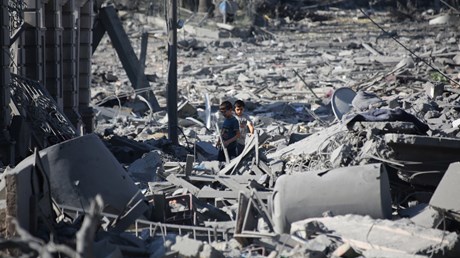
The way to resolve the Israel-Hamas war is very simple, journalist Matt Yglesias recently explained. We could do it in just five steps:

It’s great, right? I love it! Only—well, that third step seems a little tricky.

And that’s the point, as Yglesias wrote at greater length on Substack. Obviously, the five-step plan is a joke. But it gets at something that so much commentary on this subject seems to miss—certainly in America, and probably elsewhere—which is that Israeli political leaders (to say nothing of the murderers in Hamas) are not ignorant of what we outside observers believe is the right and prudent way forward.

“They just disagree,” Yglesias notes, and they are unlikely to stop disagreeing, and we are unlikely to shift their thinking much, if at all. By “we,” I partly mean the US government, which, for all its power, is objectively limited in its capacity to shift the behavior of combatants who believe, quite rightly, they are in an existential fight. But I also mean you and me specifically—as well as our fellow Christians in America and around the world.

We cannot fix this crisis, no matter how faithful, factual, and fervent we are.

This bears saying, I think, for two reasons. One is our modern habit of “awareness,” as in, I am posting this article on Facebook because I want to raise awareness.

On many issues of great import, the reality is most of us can do very little to effect significant change. Sometimes we can give money to a relevant cause. Always we can pray (1 Thess. 5:17) and take care we do not sin in our hearts or our speech as we react to the news (Matt. 5:21–30). ...

Continue reading...


from Christianity Today Magazine https://ift.tt/w3PNn4O

Chinese House Churches Find Hope for Gospel Growth Amid Post-Pandemic Turmoil

As China deals with economic woes, religious restrictions, and mass exodus, ministries see an opportunity.

Christians in China have had a difficult several years. The Chinese government kicked missionaries out of the country, tightened restrictions on religion, and cut off access to the world with its aggressive “zero COVID” policies. After a growing discontentment prompted unprecedented protests last year, the government finally dropped its pandemic restrictions.

Solomon Li, an overseas ministry leader who has served the Chinese church for the past 30 years, finally had a chance to return to China this year for the first time since the pandemic began in 2020. (Li’s name has been changed due to security risks.)

He met with 150 pastors within one urban house church network and shared with CT about the new challenges and opportunities that Christians face in this post-pandemic era. The interview has been shortened and edited for clarity.

China’s “zero COVID” policy, which aimed to keep cases as close to zero as possible with strict lockdowns and mass testing, only ended last December. How did the pandemic impact the house church leaders that you met with?

In general, it became more difficult for them to hold Sunday services, but many of them still tried to meet in person as much as they could. It also made things more difficult for fellowships and house visitations. People feared that they were spreading germs by gathering together. These were some really tough years.

One reason these churches wanted to continue meeting offline is that they were concerned about intentional ecclesiology: What is the doctrine of the church? Can online or Zoom services be acceptable in the long term? Their answer, based on the Bible, was no. Online church is the exception to the rule. If we can go out shopping, then ...

Continue reading...


from Christianity Today Magazine https://ift.tt/wdYizsM

Wednesday, November 15, 2023

The Dangers of a Psychedelic Gospel

Psychotropic drugs are often marketed as a gateway to spiritual encounters. But what are the risks to believers?

We have now had years of headlines talking about new research into using psychedelic drugs for therapy and, along with it, an increase in spiritual seekers.

Studies about the use of psychedelic drugs for therapy have been growing for years, with increased institutional involvement from universities, Congress, and the US Department of Defense to name just a few.

Outside of clinical trials, psychedelic use among young adults has nearly tripled in the past decade. Religious leaders—including hospital chaplains and religious psychotherapists—are also exploring the use of these drugs, as recently reported by NPR and Esquire. Ordained clergy are even conducting underground retreats that blend psychedelics with Christian worship with an emphasis on “healing.”

While I believe there are likely legitimate-use cases for psychedelic therapy that will bear out in time, I want to raise awareness of the many psychological risks of psychedelics that are often underemphasized in the research. And as a pastor, I feel an urgency to inform Christians of the serious spiritual risks of psychedelics—including the idolatry of spiritual experience.

I’m not speaking about this as an outsider. More than a decade ago, psychedelic experiences felt more real to me as a young ex-Christian than God did. For years, I was a recreational psychedelics user who became involved in the movement to medicalize psychedelics, also working for their use in non-Christian religious contexts. I promoted the healing potential of psychedelics, but I was even more interested in their spiritual power.

Over time, however, I grew deeply disenchanted and ultimately left the movement behind.

The psychedelic industry is plagued with many of the same ...

Continue reading...


from Christianity Today Magazine https://ift.tt/SP5kr6l

The Imprudence of ‘Dump Them’

Online pop psychology has a simple solution to every relationship problem. Love and prudence call us to something messier—and better.

Everyone on social media is asserting their boundaries. Everyone is cutting toxicity out of their life. Everyone is prioritizing their own healing journey and giving up on one-sided relationships. Everyone is disarming the narcissist, protecting their space, deleting that number, going no-contact. Or at least, it feels that way.

There is a mode of self-help, overwhelmingly generated and reinforced online, that I call the “dump them” school of thought. It solves every problem with an elegant, unified simplicity of which physicists can only dream: Just dump them. Whether it’s your mother failing to respect your child-rearing rules, your boyfriend who said something hurtful, or your friend who flaked on you twice in a row, you know what you need to do: Dump them. Cut them off.

“Dump them” conversations online are rarely about the church, but the church—universal, if not always a specific local congregation—is a highly dump-able target. The universal church is filled with sinners, and particular churches bring otherwise disparate people together in the work of governing a community and discussing profoundly sensitive and important topics; they often comprise a complex emotional landscape where quotidian frustrations mingle with histories of power abuses (or worse). It would be surprising if the “dump them” school of emotional hygiene had not made its way to the church.

It’s not difficult to see why this school of advice has gained traction. For one thing, it’s extremely well-suited to the internet, where we encounter the interpersonal problems of others at a far remove. Without being deeply embedded in the real-life context of the problem ...

Continue reading...


from Christianity Today Magazine https://ift.tt/uGQONHs

Tuesday, November 14, 2023

God’s Astonishing Announcement Scheme

A different view of a glorious arrival

The birth of Christ astonishes us.

And not only the birth itself but the way in which God decided to present his Son’s birth to the world. With no big-budget marketing plan, social media campaign, or paid TV spots during the Super Bowl, the Lord chose an unsuspecting group of shepherds to introduce good news of great joy that will be for all people. Imagine how overwhelmed these poor shepherds must have been as a multitude of otherworldly angels appeared in the dark of night, saying, “Glory to God in the highest, and on earth peace among those with whom he is pleased!” (ESV). We are caught in the throes of wonder when we consider the scale of this spectacle that God arranged for so few people so lacking in cultural influence.

But then we remember Mary, Joseph, a manger, and some animals. A scene that would make most parents shudder if they had to contemplate a birth this simple and obscure. As we grasp to envision these things, we remember that God’s idea of his Son’s divine childbirth did not include the extravagance and excess that we insist on to illustrate influence and importance.

In God’s transcendent economy, lowliness is how he wants us to understand godliness, to understand his Son. As Philippians describes, “Though he was in the form of God, [he] did not count equality with God a thing to be grasped, but emptied himself, by taking the form of a servant” (2:6–7, ESV).

God’s astonishing announcement scheme will not likely be featured in leadership books, strategic seminars, or influencer videos for how to boost your brand, gain more followers, and advance your platform. God does something far more bewildering. He sanctifies our comprehension and unravels our ...

Continue reading...


from Christianity Today Magazine https://ift.tt/6WEUfDO

Nashville Pastor Scott Sauls Resigns After Apologizing for Harsh Leadership

Sauls spent a decade leading Christ Presbyterian Church and had been on leave since May.

Scott Sauls, an influential pastor and author, has resigned from the Nashville megachurch he had led for the past decade.

Members of Christ Presbyterian Church (CPC) voted to accept Sauls’s resignation during a congregational meeting on Sunday night.

Sauls had been on an indefinite leave of absence since May after apologizing for an unhealthy leadership style. A group of church leaders known as the session had asked the Presbyterian Church in America (PCA) congregation to accept Sauls’s resignation.

In addressing the congregation, Sauls apologized to those he had hurt and said that he and his family would continue to serve Jesus.

“We had hoped to continue forward and help with CPC,” Sauls told the congregation during the meeting, according to The Tennessean, which first reported the news of Sauls’s resignation. “But we now believe the most merciful thing to do is step aside so the church can seek new leadership and we can seek the Lord’s will for whatever comes next as well.”

The church declined to comment on news of Sauls’s resignation.

Sauls’s tenure at the church began with great promise and was marked by growth. A protege of the late Tim Keller, Sauls promoted a Christianity marked by kindness and grace, rather than culture war politics, in books like A Gentle Answer: Our “Secret Weapon” in an Age of Us Against Them, Befriend, and Irresistible Faith.

Sauls admitted earlier this year that he had been harsh with church staff and used the power of the pulpit as a weapon against those who disagreed with him.

“I verbalized insensitive and verbal criticism of others’ work,” he said in an apology to the congregation earlier this year. “I’ve ...

Continue reading...


from Christianity Today Magazine https://ift.tt/sgIadFM

Keeping—and Learning—the Peace

An American Christian’s view of US-Taiwan-China relations and what to do in the event of war.

This article is published in collaboration with Campus, a Taiwanese evangelical magazine.

In the summer of 2021, American public opinion reached a new milestone: Just over half the country, per a survey by The Chicago Council on Global Affairs, supported sending US troops to defend Taiwan if China were to invade.

Since then, as cross-strait tensions have heightened and the US began supporting Ukraine in its defense against Russian aggression, American opinion has wavered. Though increasingly likely to say Taiwan-China tensions are a very serious problem for the United States, Americans are not of one mind on what our country’s policies toward Taiwan and China ought to be.

Our disagreements on this subject don’t follow clear partisan or religious patterns. Though Democrats and Republicans are strongly polarized on many issues, when it comes to Taiwan, polling shows mixed views across partisan lines.

Americans increasingly view China as an enemy and are increasingly worried Beijing will choose to invade. But ambiguity isn’t just an official US strategy; our national thinking on this subject really is ambiguous, and American Christians generally and evangelicals specifically aren’t distinct from our compatriots here.

What if China attacks Taiwan? What the United States should or would do is a truly open question in American politics, and what Taiwanese Christians should do is an even more complex question.

The last two years of escalation in tension in US-Taiwan-China relations are worrisome—most of all in those cases where such escalation could have been avoided. Careless rhetoric from US president Joe Biden and provocative but ultimately unnecessary US political visits have ...

Continue reading...


from Christianity Today Magazine https://ift.tt/yTEqfO2