Monday, November 20, 2023

Pharaoh Did You Know?

How the shepherds upended Egyptian power.
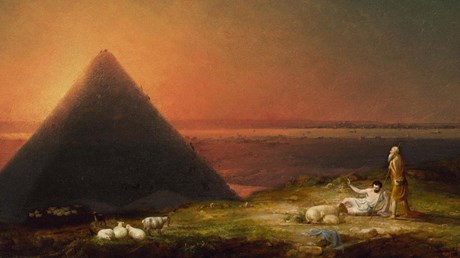
Those familiar with the Bible know how to imagine Pharaoh of Exodus: heart-hardened as he heard from Moses and Aaron, “Let my people go.” However, we don’t often think about how some words spoken centuries later may have been even more repulsive to him:

There were shepherds out in the field, keeping watch over their flock by night. And an angel of the Lord appeared to them, and the glory of the Lord shone around them. (Luke 2:8–9, ESV throughout)

Maybe what we need to understand about the Christmas story is how it would have rattled the pyramids.

The Joseph we think about this time of year is Joseph of Nazareth, the adoptive father of our Lord Jesus. But a much earlier Joseph lingers in the background of the familiar scene in Luke 2. In Genesis 46, this Joseph—a key figure in Pharaoh’s court—brought his long-lost, now-found family to Egypt to save them from famine. Joseph told them,

When Pharaoh calls you and says, “What is your occupation?” you shall say, “Your servants have been keepers of livestock from our youth even until now, both we and our fathers,” in order that you may dwell in the land of Goshen. (vv. 33–34)

Joseph seemed to be coaching them to reassure Pharaoh that they were coming not to take over, but merely to carry out their occupations without disrupting Egyptian life. The Bible tells us why: “Every shepherd is an abomination to the Egyptians” (v. 34).

This lowly occupation that was an abomination to the Egyptians becomes a recurring theme in the biblical story. Later, Moses (who, like Joseph, had been an insider in Pharaoh’s court) fled for his life and, before his encounter with God in the burning bush, spent extended time ...

Continue reading...


from Christianity Today Magazine https://ift.tt/ZmU8F0f

Flashes of Glory—and Brutality

A conversation with artist Kieran Dodds and academic Christian Gonzalez Ho on their new exhibit, ancient pilgrimage sites, and the church of the future.

This interview is a special collaboration with Ekstasis, CT’s imaginative NextGen project, and originally appeared in the Ecstatic Newsletter, an extension of Ekstasis on Substack. Together, we’re building a digital cathedral that offers space to ponder and lift our eyes to Christ in wonder.

As you scroll through this story, you are embarking on a form of pilgrimage.

We tap incessantly at our phones for the same reason our forebears traveled repeatedly to the Holy Land, says art historian Christian Gonzalez Ho: to commune with something greater than ourselves, to express a “longing to go to another place, or to have another place reach [us].”

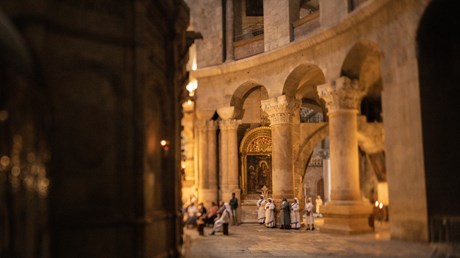
Gonzalez Ho and photographer Kieran Dodds are the creators of a new exhibit, “Heading Home: Glimpses of New Jerusalem,” running this fall and winter at the Ahmanson Gallery in Irvine, California. Featuring Dodds’s photographs of pilgrimage sites on the route between London and Jerusalem, placed in an interactive gallery space designed by Gonzalez Ho, “Heading Home” asks us to revisit the ancient practice of pilgrimage and consider its relationship with contemporary Christianity.

Images of stops along the pilgrimage route—the Florence Duomo, the Church of the Holy Sepulchre—are paired with sound installations and physical structures that reinterpret the experience of interacting with each site. Christianity Today spoke with Dodds and Gonzalez Ho about the possibilities and challenges of interpreting these sites for modern believers.

This interview has been edited and condensed.

Let’s start with the origins of this exhibit. Why did you two choose to focus on this topic for this moment?

Kieran Dodds: I was invited on this ...

Continue reading...


from Christianity Today Magazine https://ift.tt/kRgdXyz

Loaves and Casserole Dishes: Will Church Cookbooks Survive?

The spiral-bound tomes guarding the secrets of the best sugar cookies, sheet cake, and seven-layer salad are disappearing–but not completely.

Did someone say Jell-O salad?

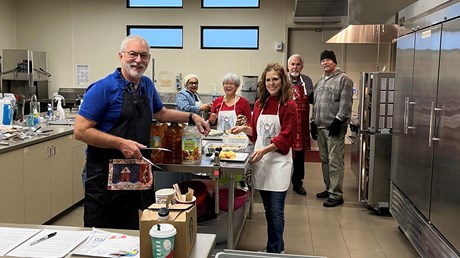
This is the time of year when families pull out their stained recipes to make crowd-pleasing casseroles, cakes, and cookies. Some of those favorite recipes come from church cookbooks, compiled by women over the decades since the 19th century.

These spiral-bound collections of recipes have been a staple in church culture, documenting the tastes and traditions of their communities over the years. But now, as cookbook enthusiasts age, the victual volumes are disappearing.

Tallowood Baptist Church in Houston used to print cookbooks filled with recipes for sheet cakes and soups, and members would make the dishes in a potluck to share. But it’s been eight or nine years since their last edition.

“The people who were dedicated to the project are no longer with us, and no one has thought of doing another cookbook,” said Joy Cryer, a church librarian at Tallowood.

It only takes one enthusiastic person in a church to compile recipes from members, but the internet has changed the way people cook and gather recipes. And Americans of all socioeconomic statuses generally cook less than they used to.

Though the church cookbook tradition has declined, it might be too early to declare it over. CT surveyed 22 church librarians, and more than a third said they knew of churches that were still printing cookbooks.

In Oshkosh, Wisconsin, 84-year-old Mona Schultz attends Plymouth Church, a nondenominational church of about 250. She wasn’t sure if anyone cooked much anymore, or if there would be interest in doing a church cookbook. She asked a young women’s Bible study at her church what they thought of the idea.

“I’m 84, I’m out of touch,” said Schultz, who has been going ...

Continue reading...


from Christianity Today Magazine https://ift.tt/3Mbo4DP

Friday, November 17, 2023

As Philippines’ Drug War Rolls On, Christians Continue Their Work

Duterte tried a hardline policy. Marcos is prioritizing rehab. Christians point to Jesus.

While running for office last year, Philippines president Ferdinand “Bong Bong” Marcos Jr. promised to seek a new path to curb illegal drugs: Catch the “big fish” and rehabilitate drug users.

“Let’s educate the younger ones,” Marcos said in a Taglish interview. “And those who are already involved [or already addicted], we should treat them. … We’re trying to formulate … the best way for the rehabilitation.”

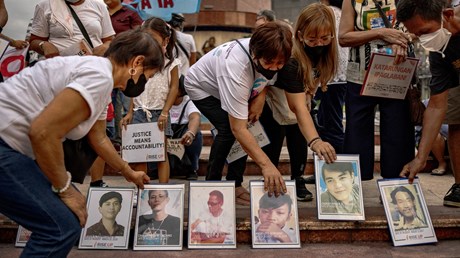
It’s a starkly different approach from his predecessor, Rodrigo Duterte, who outraged Filipinos and the international community with his brutal war on drugs, giving police blanket authority to kill anyone found using or dealing drugs.

During Duterte’s six-year presidential term, government data reported around 6,000 drug-related killings. Human rights groups, however, peg the number much higher, estimating that up to 30,000 people were killed.

“I will never, never apologize for the deaths,” Duterte said in January 2022. “Kill me, jail me, I will never apologize.”

Since taking office, Marcos has established more than 100 community-based drug rehab centers that provide drug users with temporary shelter and reintegrate them into society. Today there are nearly 500 of these centers, called Balay Silangan Reformation Centers, in the Philippines.

However, during the first year of Marcos’s presidency, the number of drug-related killings actually increased from the last year of Duterte’s term, according to a recent report by the Dahas Project at the University of the Philippines’ Third World Studies Center. They counted 342 killings from Marcos’s inauguration in July 2022 until June 2023, 40 more ...

Continue reading...


from Christianity Today Magazine https://ift.tt/v6VYEhd

American Christians and the Anti-American Temptation

Christians can love America—with all of its flaws and failures—precisely because we don’t expect it to be the kingdom of God.

This piece was adapted from Russell Moore’s newsletter. Subscribe here.

If any political idea in American life has proven itself over the past several years, I can’t think of a better candidate than the “horseshoe theory”—the notion that, at their extremes, Left and Right bend toward each other, sometimes as to be almost indistinguishable.

One of the ways we can see this is in a bleak and darkening view of the United States of America. The question is not so much whether extremists of the Right or Left seem to hate America these days as much as it is the question of why.

Over 15 years ago, then-candidate for president Barack Obama’s campaign was rocked by a videotape of sermons from Obama’s pastor, Chicago preacher Jeremiah Wright, in which Wright spoke of the September 11 attacks in language reminiscent of that of Malcolm X after the John F. Kennedy assassination, as “chickens coming home to roost.”

Wright denounced the idea of “God bless America,” replacing it with instead a call of “God damn America.” The controversy proved to have no staying power—not because most Americans would agree with Wright but because almost no one really believed that Obama himself held to such views. In fact, Obama repudiated his pastor and left the church.

Wright’s bleak view of America was not unusual for a specific strand of the further reaches of the American Left, at least since the Vietnam era. Counter-culture protesters, after all, once burned American flags and referred to the country as “Amerika,” equating the United States with an imperialist dictatorship.

In more recent years, some initiatives such as the 1619 Project have gone beyond ...

Continue reading...


from Christianity Today Magazine https://ift.tt/nvdxO72

Thursday, November 16, 2023

Displaced from Israeli Border, Lebanese Presbyterians Wrestle with Whom to Blame

As limited clashes with Hezbollah threaten to expand Israel’s war against Hamas, local evangelicals suffer a battle not of their making.

Rabih Taleb looked out from the pulpit at the 30 nervous believers gathered at the Evangelical Presbyterian Church of Alma al-Shaab in southern Lebanon, located less than one mile from northwest Israel. One day earlier, Hamas terrorists had killed 1,200 mostly civilian Israelis 125 miles south on the Gaza border.

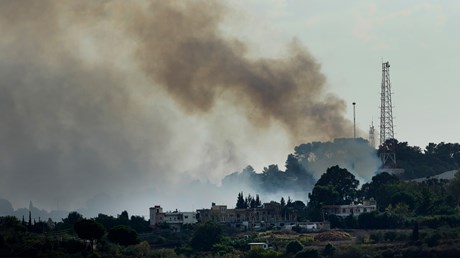
That Sunday morning, Hezbollah, the Lebanese Shiite militia designated as a terrorist entity by the United States government, fired rockets into the disputed Sheba Farms enclave occupied by Israel but claimed by Lebanon. And as Israel began its massive bombing campaign against Hamas in Gaza, it also shelled Hezbollah positions 35 miles east of Alma al-Shaab.

A few families immediately fled, including the elder who leads worship, forcing the hymns into a cappella. The rest of the congregation pressed Taleb for a shortened service, all eager to return home and prepare for the worst. But the sermon topic—the second in a series on distinctives of Reformed faith—appeared divinely appointed. Little adjustment was needed to discuss original sin, suffering, and pain.

“They ask me: Why are we always facing these difficulties?” Taleb said. “We are believers. Why is there always war, war, war?”

Sources said this was their seventh displacement in the last 50 years.

Alma al-Shaab, one of about a dozen entirely Christian villages near the Israeli border, has a year-round population of about 700 people, Taleb said. Today only about 20 remain, including the Maronite Catholic priest who conducts services—now welcoming all sects—when there are lulls in the fighting.

Taleb and his family left Alma al-Shaab on October 9 when a bomb fell in a field only a three-minute drive from his church, ...

Continue reading...


from Christianity Today Magazine https://ift.tt/5nGYJbi

Skeptical of Politicians and Parties, Gen Z Isn’t Pumped for the 2024 Race

But on Christian campuses, first-time voters are still trying to find their own ways to engage the issues.

Gen Z Christians are creating their own playbook when it comes to the intersection of faith and politics.

Whether they’re growing more cynical of partisan politics or finding hope in the power of political change, this generation sees itself branching out beyond the issues that have long driven the Christian Right.

Younger believers are quicker to name creation care, prison reform, and immigration as the political causes most influenced by their faith, rather than abortion or sexuality. But even those who seek to get involved in politics don’t align as closely with the two major parties in the US and aren’t excited at the prospects for 2024.

At Calvin University, Micah J. Watson has noticed a shift amongst college students.

“I do think there has been a weariness among Gen Z in some of the ways their parents and grandparents did politics in the 1970s, ’80s, and ’90s,” said Watson, associate professor and director of the politics, philosophy, and economics program. “Some of the culture war practices have been seen as problematic.”

For young Christians who have the chance to vote in their first presidential election next year, the milestone comes with trepidation, knowing the political polarization that surrounded the races in 2016 and 2020.

“Having gone through COVID and Trump and Biden elections, students have seen parents’ relationships going down the tube,” Watson said, “and there’s a fear of expressing one’s views and being canceled.”

Growing up, Rachel Smith remembers her mother adorning the family car with political bumper stickers to reflect both their party affiliation and their Christian values. But Smith, ...

Continue reading...


from Christianity Today Magazine https://ift.tt/sW7XJAt