Monday, September 11, 2023

How Christians Can Break the Stronghold of a Curse-Informed Worldview

A Nigerian pastor refuses to live his life by this framework—and he wants to help the African church get there too.

Godwin Adeboye saw something interesting where residents of Ibadan, a city in southwest Nigeria, were dumping their garbage.

At one location where people left trash, the government had posted a sign saying, “Do not drop your refuse here. If you do so, the government will charge you.”

In another spot, someone else had written a different message: “If you put your dirty material here, I curse you in the name of my family god.”

“If somebody says, ‘If you dump refuse here, you will die young, lose your fortune, or lose all your children in one day,’ nobody goes there, because they fear curses,” said Adeboye, a pastor and research director at ECWA (Evangelical Church Winning All) Theological Seminary in Igbaja, Nigeria.

The weight of curses wasn’t just something that Adeboye saw from a distance. When he experienced numerous family members die, seemingly from mysterious causes, many suggested that curses might responsible. These arguments led Adeboye to study this phenomenon from a biblical perspective and author Can a Christian Be Cursed? (Langham, 2023).

“I wrote this book out of my own experience and what I see my African brothers and sisters experiencing,” he said. “Many Africans, even Christians, sometimes believe their financial, moral, or marital failures are because a particular ‘spiritual’ curse is tormenting them, instead of taking personal responsibility.”

Further, Adeboye felt compelled to address a significant issue in African Christianity from an African Christian perspective.

“I’ve read many books written on African Christianity, and many authors are not empathetic to the African experience,” he said. “To make ...

Continue reading...


from Christianity Today Magazine https://ift.tt/fuw1Eem

4 in 10 Evangelicals Say They’ve Been Visited by the Dead

Despite Scripture’s warning against communication from beyond the grave, most consider hearing from loved ones to be a comfort in their grief.

Last summer, Heather Beville felt something she hadn’t in a long time: a hug from her sister Jessica, who died at age 30 from cancer.

In a dream, “I hugged her and I could feel her, even though I knew in my logic that she was dead,” she said. She immediately texted a group chat with her close friends, including her husband and her pastor, to tell them about it.

Like fellow Christians, Beville is sure that death is not the end. But she’s also among a significant number who say they have continued to experience visits from deceased loved ones here on earth.

In a recent Pew Research Center survey, 42 percent of self-identified evangelicals said they had been visited by a loved one who had passed away. Rates were even higher among Catholics and Black Protestants, two-thirds of whom reported such experiences.

Interactions with the dead fall into a precarious supernatural space. Staunch secularists will say they’re impossible and must be made up. Bible-believing Christians may be wary of the spiritual implications of calling on ghosts from beyond. Yet more than half of Americans believe a dead family member has come to them in a dream or some other form.

The survey didn’t clarify how people processed these interactions—whether they thought they were mystical or believed they could have had natural causes. Those who responded that loved ones visited them in a dream, for example, included those who may believe their loved ones were trying to send messages to them as well as those who might have simply dreamt about a favorite memory with their family member.

Experiencing these interactions is correlated with some sense of religious faith. Sixty-three percent of people with ...

Continue reading...


from Christianity Today Magazine https://ift.tt/KxD8ryi

Friday, September 8, 2023

Singleness Is Not a Sin

But in Scripture, church history, and singles' own accounts of their lives, it's usually not a good thing, either.

Is it a sin to be single?

To a modern ear, the question can sound bizarre—but in many circles of Christianity, especially online, the question of whether young people (especially young women, as in a recent viral TikTok video) are engaged in sinful behavior by being single into their late 20s or 30s is earnestly asked and debated. Yet in other circles, a diametrically different question is asked: Could it be a blessing to be single? Doesn’t Paul say he wishes that everyone could be unmarried as he was (1 Cor. 7:7–8)?

The proximate cause of the debate within Christianity about singleness is not mysterious: The share of people ages 18–35 who are married has fallen from 59 percent in 1978 to 29 percent in 2018. Marriage is coming later in life or not at all, so there are a lot more single adults in society and in many churches. Because marital status is strongly associated with political and religious views (single people are generally more liberal and less religious), many conservative Christians see in the rise of singleness a plausible source of the general turn away from faith in American life.

But for Christian single adults, the story is quite different. Most Christian singles do desire to marry someday; in a survey of regularly church-attending single women under 35, my consulting firm found that the average desired family size was 2.7 children, versus just 2 children for never-attending single women or 2.8 for regularly attending married women. Christian singles have about the same family aspirations as their married peers. They are unmarried not mostly because of a lack of desire but because of factors not strictly within their control: family and churches who discouraged hasty and young marriage, ...

Continue reading...


from Christianity Today Magazine https://ift.tt/Ugbv93K

In a World of Speed and Power, Cormac McCarthy Wasn’t Afraid of Depth

The late novelist’s final books are ambitious portraits of the Western world and the human soul.

In the Middle Ages, there was a popular group of texts that made up the so-called contemptus mundi genre (which, loosely translated, could mean “how to develop a visceral disdain for the world”). One of the genre’s most famous works is Thomas à Kempis’s Imitation of Christ. These rather “Platonic” works, in the sense of being in the vein of the philosopher Plato, were intended to coach Christians toward holiness, teaching them how to pry their fingers loose from the throat of life and begin longing for heavenly, immaterial realities.

This was done through contemplating things that now seem off-putting to us: how treacherous people in the world are, how you were born in woe and will die in suffering, and all of the icky things about the human body. The goal was to drag those things we try to forget (mainly the “Four Last Things”: death, judgment, heaven, and hell) out from the hiding places of our consciousness, lest we forget how fleeting, disappointing, and volatile this world ultimately is.

Just a couple of years ago, I would have considered the contempus mundi genre dead, with the possible exception of a brief revival in T. S. Eliot’s late religious poetry. But the late novelist Cormac McCarthy resurrected the genre in his final books, The Passenger and Stella Maris, which were released as a pair late last year.

Although the two books are less violent than The Road or Blood Meridian, they partly compensate for that with their raw language, crude jokes, suicidal longings, and graphic descriptions of incestuous sexual desire. McCarthy was no plaster angel, even in his later years. But even though McCarthy’s novels do deal frankly with these strong and off-putting ...

Continue reading...


from Christianity Today Magazine https://ift.tt/QSwOcCZ

Christian Politician Awaits Finnish Court’s Verdict on Hate Speech Charges—Again

Päivi Räsänen says quoting the Bible should not be a crime in a democracy.

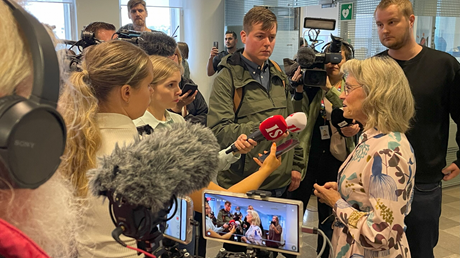
The facts are the same. The arguments, the same. But for two days in an appeals court in Helsinki, prosecution and defense rehashed the arguments that previously cleared Finnish politician Päivi Räsänen and Evangelical Lutheran Mission bishop Juhana Pohjola of charges of criminal incitement against a minority group.

State prosecutors argued there was a mistake last March. They say the district court weighed the evidence incorrectly, setting the threshold for “incitement” too high. According to them, a pamphlet the former minister of the interior published with a conservative Lutheran press in 2004, and comments she made about homosexuality on Twitter and on a national radio show in 2019, should be judged as hate speech.

State prosecutor Anu Mantila says Räsänen’s comments are not only disagreeable and offensive, but harmful.

“Offensive speech has a damaging effect on people,” she said.

Mantila said Räsänen’s statements characterized homosexuality as immoral and as a psychosocial developmental disorder. Räsänen describes same-sex attraction as unhealthy and abnormal—something that requires treatment. According to the state, that “devalues and denigrates homosexuals.”

“If you put all the statements together,” she said, “it is clear that they are derogatory towards homosexuals. Condemning homosexual acts condemns homosexuals as human beings.”

The prosecutor also argued there is no religious defense for that kind of hate speech.

“You can’t say anything under the guise of religion,” Mantila said. “You can cite the Bible, but it is Räsänen’s interpretation and opinion about ...

Continue reading...


from Christianity Today Magazine https://ift.tt/pLWdwvP

It’s Eden Somewhere

The late Jimmy Buffett’s songs and the writings of Tolkien both long for a home just beyond reach.

This piece was adapted from Russell Moore’s newsletter. Subscribe here.

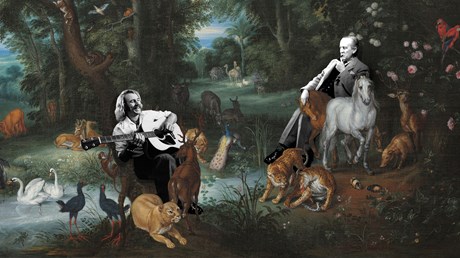
One cannot imagine Jimmy Buffett and J. R. R. Tolkien in a room together, sharing a “cheeseburger in paradise” at The Eagle and Child. Tolkien was drawn to “northernness,” to Icelandic myths and elvish languages. Buffett captured the breezy exuberance of Caribbean rum. And yet both merged without rancor into my life from childhood on, somewhere between Middle-earth and Margaritaville.

And then last week, Jimmy Buffett died—on the 50th anniversary of the death of Tolkien. Both of them, I think, have something to remind us about the meaning of mortality.

As I’ve written here before, my wife often tells people that if they really want to know me, they should know that my most listened-to artist is not who they think it is (Johnny Cash); it’s Jimmy Buffett.

That makes sense, of course. Buffett was from Pascagoula, Mississippi, a couple of towns over from my hometown of Biloxi, Mississippi. Buffett and I both went, a generation apart, to the University of Southern Mississippi. Though, his biographer Ryan White notes that he spent more time where the action was: in New Orleans “and its scrappier Gulf Coast neighbor—Biloxi,” a city that White describes as having “scars and a temper and ill-considered tattoos.”

I don’t have much of a temper, and have no tattoos, but the description isn’t really wrong. When Buffett sings “Biloxi,” I feel like I’m home.

My wife says what’s really telling is that the songs I listen to over and over again aren’t the “Don’t Chu-Know” type of cruise-ship party songs. What resonates with me is the melancholy, ...

Continue reading...


from Christianity Today Magazine https://ift.tt/mOtG574

Thursday, September 7, 2023

He Loved the Lisu People and Even Co-Invented the Script of Their Language

Bible translation and writing was an important part of James O. Fraser’s missionary work in the Nujiang mountains 100 years ago.

In the remote mountains and ancient forests of China’s Nujiang Grand Canyon, near the Myanmar and Tibet borders in Yunnan province, live the Lisu people (傈僳族).

One of the country’s 55 ethnic minorities, the community of about 900,000 is majority (80%) Christian, and the faith has been present among the people for over a century.

The history of the sowing, germination, flowering, and fruiting of the gospel among the Lisu and the development of their written language trace back to the 1910s, with a missionary from England named James Outram Fraser.

Love at first sight

In 1908 at the age of 22, Fraser (Chinese name Fu Neng Ren 富能仁) was a talented student who gave up the promising future of an engineering career to join Hudson Taylor’s China Inland Mission (CIM). His move across the world was inspired by the Student Volunteer Movement as well as by a mission mobilization leaflet one of his Imperial College London schoolmates gave him, which included the following sentences:

If our Master returned today to find millions of people (in China) unevangelized, and looked, as of course He would look, to us for an explanation, I cannot imagine what explanation we should have to give. Of one thing I am certain—that most of the excuses we are accustomed to making with such good conscience now, we shall be wholly ashamed of then.

Convicted and compelled by this argument, Fraser boarded a ship to China in 1910 and disembarked in Tengchong (formerly Tengyueh, a city in Yunnan province and a key stop along the Silk Road).

A hundred years ago, the local ethnic minority Lisu were extremely poor, and their living conditions were miserable. The agricultural method then was “slash and burn.” People lived in raised ...

Continue reading...


from Christianity Today Magazine https://ift.tt/wolU6i3