A religious undercurrent mandates we stay calm and not panic as cultural oceans roil.
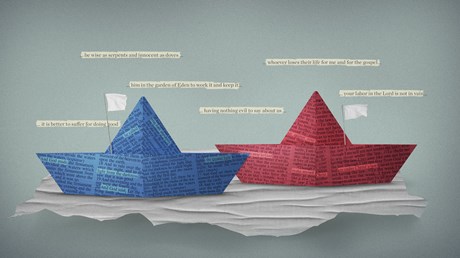
In 2017, nine people were caught in a riptide off a Panama City beach. Over 80 onlookers formed a human chain extending 100 yards into the Gulf of Mexico, rescuing the last person after just an hour. Riptide deaths usually result from people swimming against the tide until they lose the energy to resist its pull.
Similarly, Christ’s followers tread dangerous waters when trying to navigate America’s sociopolitical currents. How might churches overcome the loss of energy and resist political riptides? America’s polarization current is only part of the story. In 2016, 1 in 10 Bernie Sanders supporters voted for Donald Trump in the general election. How was that possible? According to the conventional left-right spectrum, this makes no sense. What else is going on?
A religious undercurrent, which we call “political denominationalism,” moves just below the surface of our political discourse. Mere opinions are no longer allowed; one must have unwavering convictions. Political commitments increasingly define us, yet at the same time, are increasingly irrelevant. Other forces now pull us.
Modernity affirmed an ordered world discernible through rational, scientific inquiry. It rejected the authority of religious and private beliefs in favor of progress and technological advance. Conversely, postmodernism rejected claims that history progresses or possesses any inherent meaning.
Add the contrast between modern and postmodern to the classic divide between liberal and conservative, and political perspectives get even more complicated. In the accompanying illustration below, the left-right spectrum represents America’s liberal-conservative continuum. The vertical line represents the modern-postmodern continuum. ...


from Christianity Today Magazine https://ift.tt/3iE4BV3

No comments:
Post a Comment